
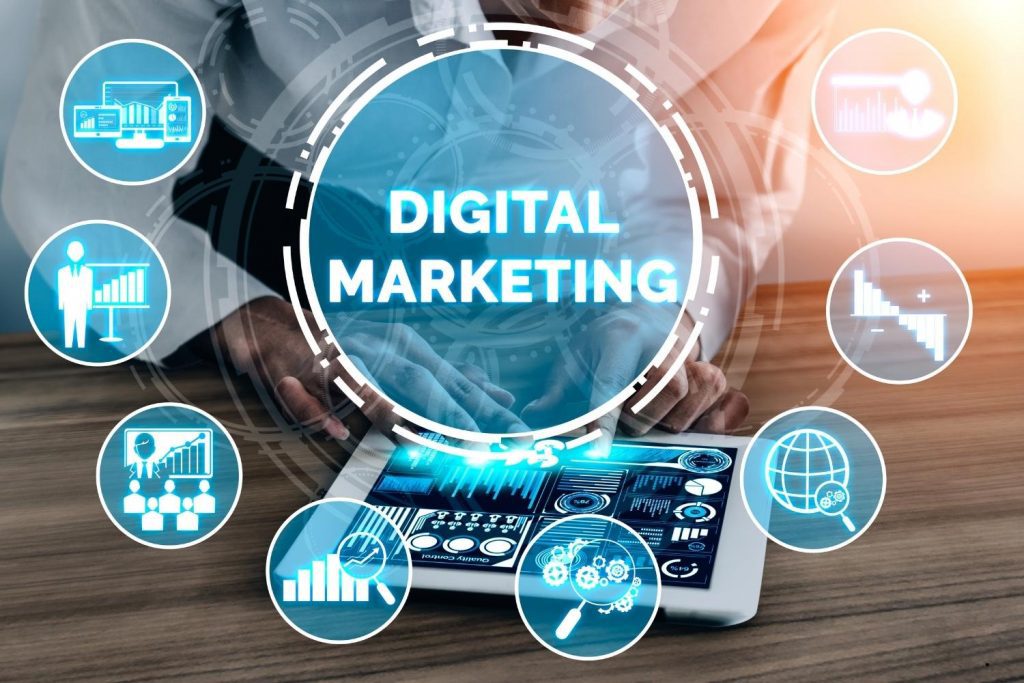
Digital marketing is the practice of promoting products, services or brands through digital channels — the internet, search engines, social media platforms, email, mobile apps and more. If a customer finds your business through a Google search, sees your ad on Instagram, or receives a promotional email from you, they have experienced digital marketing.
The term covers a wide range of activities — and that is part of what makes understanding what is digital marketing so valuable. Some are focused on getting found (SEO). Some are focused on paying for visibility (Google Ads). And some are about building relationships over time (email, social media, content). What they share is the medium: all of it happens online, and all of it can be measured in ways that traditional marketing cannot.
Simple definition: What is digital marketing? It is using the internet and digital platforms to reach, engage and convert your target audience. Every other question — which channels, which tools, which budget — follows from this.
What is Digital Marketing? The Complete Guide for 2026
Definition
So, if you ask, what digital marketing is? My simple answer would be- Digital Marketing refers to all the marketing activities that are done online. As more and more audience is over the internet today, businesses use digital channels like search engines, social media, email and websites to reach and connect with their potential customers.
In practice, digital marketing is a broader concept. It involves organic channels like SEO and content marketing and paid channels like Google Ads and programmatic advertising.
Simple Explanation
Let me explain it to you with an example.
Suppose, you own a restaurant in Patiala. Twenty years back, you would let public know about it by putting up an ad in the newspaper, distribute the flyers to shopkeepers in the area or to students outside college or institutes, or you could ask your customers and people walking past your restaurant to spread the word. This is called traditional marketing. It is very expensive and hard to measure. Also, it reaches everyone, whether they’re your customers or not.
Today, you can run a Google Ad that shows only when someone in searches for ‘fine-dining restaurants near me.’ You can make your page on Instagram and reach people in your city who follow food-related accounts. You can ask your existing customers for their email ids and send them a discount coupon every Wednesday. Here every rupee you spend can be tracked through results.
This is what is called digital marketing. It is reaching the right people at the right time through the right channel. And most importantly, knowing, if it worked.
Traditional Marketing vs Digital Marketing
| Factor | Traditional Marketing | Digital Marketing |
| Reach | Local or regional | Global — no geographic limit |
| Cost | High (print, TV, outdoor) | Flexible — starts from zero |
| Measurability | Difficult to track | Fully measurable in real time |
| Targeting | Broad audience | Precise — age, interest, location |
| Feedback | Slow — weeks or months | Instant — same day |
| Editing | Cannot change once printed | Change anytime, mid-campaign |
| Examples | Newspaper ad, TV spot, brochure | Google Ads, SEO, Instagram post |
Key insight: Traditional marketing is about broadcasting to everyone. Digital marketing is about reaching the right person precisely.
Digital Marketing Scope in India: Jobs, Salary, and Demand
Why Digital Marketing Matters in 2026?
The concept of digital marketing has changed a lot in the past two years. Today, it is not only about having a website or running ads of Facebook. It is very different from what most people think it is. And it it very important to understand why digital marketing matters a lot today. Let’s first check out what has actually changed.
Internet and Mobile Growth
Today, there are around 900 million internet users in India and the numbers are rapidly growing. And for someone who wants to understand what is digital marketing and why it matters, the numbers itself tell a clear story. The audience has moved online and this is not something that is going to slow down. If you talk about Punjab particularly, cities like Patiala, Rajpura, and Sangrur now have well-connected markets where local businesses can compete digitally in ways that were simply not possible seven years back.
Today, almost every business, be it a clothing brand or a pharmaceutical company, or a food outlet, have moved online. And most of the customers research online before they buy anything. They’ll compare different options, read reviews, and then make the buying decision. In this digital age, if you don’t have a strong presence online, you’ll loose your customer to your competitor.
The AI Revolution
In 2026, AI has immensely changed the way people search information online. Instead of using only search engines, people now mainly use AI tools like ChatGPT, Gemini, and Perplexity to find quick answers. Now, Google also shows the AI results on top of the search results. So today, if you are optimising only for search results, you may not appear where your customers are looking for you.
At the same time, AI has made digital marketing much easier and affordable. Today, even small businesses can create high quality content, design ads, and understand customer data using AI tools, which were earlier accessible only to large companies.
Consumer Behaviour Has Changed
The consumers have become smarter in 2026. They research everything before they make the buying decision. So, if we talk about an average B2C customer, he’ll interact with a brand 6 to 8 times on different channels before he makes a purchase. And when it comes to B2B buyer, he’ll research 10 times before speaking to a salesperson. Now, this means that the old model- ‘place the ad once and wait for calls’ does not fit here.
This means the old model of ‘place one ad and wait for calls’ does not match how real purchase decisions happen. Digital marketing — which allows you to appear across multiple touchpoints, provide helpful content at each stage, and retarget people who showed interest — is the only way to align with how customers actually behave.
Mobile-First World
Over 80% of digital interactions in India now happen on a mobile device. If your website loads slowly on a phone, your Google ranking suffers. If your email template is not mobile-friendly, it gets deleted. And if your social media content is not designed for vertical screens, it gets scrolled past. Mobile is not an afterthought in digital marketing — it is the primary context in which everything happens.
Evolution of Digital Marketing
Early Internet Era (1990s–2000s)
Digital marketing began as simple banner ads on early websites. If you had a website at all, you had an advantage. Email marketing started in this era — bulk emails sent to anyone whose address you could find, with no personalisation and no real measurement. Search engines existed, but SEO was as simple as stuffing keywords into a page.
Google Era (2000s–2010s)
Google changed everything. When Google’s search algorithm became sophisticated enough to reward genuinely useful content, SEO became a real discipline. Google Ads (originally called AdWords) allowed businesses to bid for search placement, and the entire concept of ‘pay per click’ transformed online advertising. For the first time, a small business could compete with a large one based on the relevance and quality of their digital presence, not just their advertising budget.
Social Media Era (2010s–2020s)
Facebook, Twitter, Instagram, LinkedIn and YouTube created entirely new marketing channels built around communities, content and relationships. Social media marketing emerged as a discipline, followed by influencer marketing as individual creators built audiences that rivalled broadcast media in size and engagement. Meta Ads (Facebook Ads) became one of the most powerful targeting tools ever built — allowing advertisers to reach people based on their interests, behaviours, life events and social connections.
AI Era (2026)
We are now in what most practitioners are calling the AI era of digital marketing. Generative AI tools have compressed content production timelines. Google’s AI Overviews and AI Mode have changed how search results are presented. Answer Engine Optimisation (AEO) and Generative Engine Optimisation (GEO) have emerged as disciplines focused on being cited by AI systems, not just ranking in traditional search. Performance Max campaigns have made Google Ads heavily algorithmic, requiring a different kind of expertise than manual campaign management did.
The marketers who are succeeding in 2026 — those who understand what digital marketing is becoming — treat AI as a tool within a broader strategy — not as a replacement for thinking, creativity or human judgment.
Types of Digital Marketing
When people ask what is digital marketing, they often expect a single answer. But digital marketing is not one thing. It is a collection of channels and disciplines, each with its own techniques, tools and expertise. Here is a clear breakdown of the major types:
| Type | Goal | Example |
| SEO | Rank on Google organically | Blog post appearing on page 1 |
| Google Ads (PPC) | Pay for top placement | Ad at top of search results |
| Social Media Marketing | Build audience, engagement | Instagram brand page |
| Meta Ads | Reach targeted Facebook/IG audience | Product ad targeting women 25–35 |
| Content Marketing | Educate, attract, convert | YouTube tutorials, blog guides |
| Email Marketing | Nurture leads, drive repeat sales | Newsletter with discount offer |
| Affiliate Marketing | Drive sales through partners | Blogger earns commission per sale |
| Influencer Marketing | Build trust through creators | Celebrity reviewing your product |
| Video Marketing | Engage through visual content | YouTube ad, Instagram Reel |
| WhatsApp Marketing | Direct communication | Promotional message to subscribers |
| Local SEO | Rank in map results | ‘Near me’ search for your shop |
| Performance Marketing | Pay only for measurable results | Cost per lead, cost per sale |
Most successful digital marketing strategies use several of these channels together. For example, a new product launch might combine SEO content for long-term organic visibility, Google Ads for immediate traffic, Instagram posts and Reels for brand awareness, email to existing customers, and influencer partnerships for credibility.
No single channel works for every business. The right mix depends on your audience, budget, goals and competitive landscape.
Explore the types of Digital Marketing
How Digital Marketing Works — The Customer Journey
Understanding what is digital marketing means understanding how customers actually make decisions. That process — called the customer journey — typically moves through five stages:
Awareness
The customer becomes aware that a problem or need exists. At this stage, they are not searching for your brand specifically — they are searching for information. A student looking for career options might search ‘what is digital marketing’ or ‘careers after graduation’. A business owner might search ‘how to get more customers online’.
Your goal at the awareness stage is to be present where these questions are asked — through SEO content, social media posts, YouTube videos, or informational ads. You are not selling yet. You are being helpful.
Consideration
The customer knows what they need and is now evaluating options. They might search ‘best digital marketing course in Chandigarh’ or ‘Google Ads vs Facebook Ads for small business’. They are reading comparison content, watching reviews, and shortlisting providers.
Your goal here is to be in that shortlist — through detailed comparison content, case studies, testimonials, and retargeting ads that keep you visible as they research.
Conversion
The customer decides to take action — make a purchase, submit an enquiry form, call a phone number, sign up for a course. This is the moment that digital marketing is ultimately working towards.
Your goal at this stage is to remove friction. Fast-loading landing pages, clear calls to action, simple checkout processes, and trust signals like reviews and guarantees all help conversion happen.
Retention
Getting a customer is expensive. Keeping them is much more efficient. Email marketing, loyalty programmes, personalised recommendations, and excellent post-purchase communication are how digital marketing supports customer retention.
A customer who buys from you twice is vastly more valuable than a customer who buys once. Retention marketing is the often-neglected stage that makes the difference between a struggling business and a growing one.
Advocacy
The best customers become promoters — they recommend you to friends, leave positive reviews, share your content. Digital marketing can support this through referral programmes, review generation campaigns, shareable content, and community building on social platforms.
Every stage of the customer journey requires a different digital marketing approach. One campaign cannot do all five jobs.
The Digital Marketing Funnel Explained
The marketing funnel is a model that maps the customer journey onto three broad stages. Understanding the funnel helps you plan which content and channels to use at each point.
TOFU — Top of Funnel (Awareness)
At the top of the funnel, your audience is broad. They may not know your brand at all. The goal is to reach as many relevant people as possible and make them aware of your existence and what you offer.
- Channels: SEO blog content, social media posts, YouTube videos, display ads, podcast appearances
- Content type: Educational articles, how-to guides, explainer videos, infographics
- Metric: Impressions, reach, new users, video views
MOFU — Middle of Funnel (Consideration)
The middle of the funnel is where interested people evaluate whether you are the right choice. They know they have a problem; they are deciding who should solve it.
- Channels: Email sequences, retargeting ads, webinars, comparison content, testimonials
- Content type: Case studies, product demos, comparison guides, free trials
- Metric: Email sign-ups, demo requests, time on page, return visits
BOFU — Bottom of Funnel (Conversion)
At the bottom of the funnel, someone is ready to buy or enquire. Your job is to make that decision as easy as possible and give them the final push they need.
- Channels: Google Search Ads (branded + competitor keywords), email with offers, landing pages
- Content type: Free consultations, discounts, guarantees, direct CTAs
- Metric: Conversions, cost per lead, revenue, enquiries
Real Example
A student exploring what is digital marketing and how it leads to a career might follow this path:
- Find a ‘what is digital marketing’ article on Google (TOFU — SEO)
- Click a retargeting ad for 1313 DMI after leaving the site (MOFU — paid retargeting)
- Receive an email about a free demo class (MOFU — email)
- Click ‘Book Free Demo’ and fill the form (BOFU — conversion)
Each touchpoint plays a different role. If any stage is missing, the customer journey breaks.
Core Digital Marketing Channels
Organic Channels
Organic channels are free to use but require time and consistent effort. The key organic channels are:
- SEO (Search Engine Optimisation) — appearing in Google search results without paying
- Content marketing — blogs, videos, podcasts, guides that attract and educate
- Organic social media — Instagram, LinkedIn, YouTube posts that grow your audience
- Google Business Profile — appearing in local map results
Organic channels build compounding long-term value. An article that ranks on page one of Google keeps delivering traffic for years. That is why content and SEO are the foundation of most serious digital marketing strategies.
Paid Channels
Paid channels deliver immediate visibility in exchange for a budget. The moment you stop paying, the traffic stops. But the targeting precision and speed of paid channels make them essential for driving results quickly.
- Google Search Ads — appear at the top of search results for specific keywords
- Google Display Ads — image-based ads shown across millions of websites
- Meta Ads (Facebook and Instagram) — highly targeted ads based on interests and demographics
- YouTube Ads — video ads shown before or during videos
- Performance Max — Google’s AI-powered campaign type that spans all its properties
Owned Media
Owned media is the digital property you control completely: your website, your email list, your app. This is the most valuable long-term asset in digital marketing because you are not dependent on an algorithm or platform policy.
- Website and landing pages
- Email subscriber list
- Mobile app
- WhatsApp broadcast lists
Earned Media
Earned media is visibility you did not pay for and did not create yourself. It comes from others talking about you — press coverage, social media shares, reviews, backlinks. Earned media is the hardest to generate and the most trusted by audiences.
- Press mentions and news coverage
- Backlinks from other websites
- Social media shares and tags
- Customer reviews on Google, Justdial, Trustpilot
Essential Digital Marketing Skills
Digital marketing is a broad field with many specialisations. You do not need to master everything — but you need a working understanding of the core disciplines, and depth in at least one or two areas.
SEO
Understanding how search engines work, how to conduct keyword research, how to optimise a web page, and how to build authority through content and links. SEO is the foundation of long-term organic visibility.
Paid Advertising
Running campaigns on Google Ads and Meta Ads. In 2026, this means understanding Smart Bidding, Performance Max, Advantage+ campaigns, and how to set up accurate conversion tracking through GA4. The manual bidding era is largely over; working with the algorithm effectively is the current skill.
Analytics
Reading data and making decisions based on it. GA4 is now the standard analytics platform. Being able to build reports, understand conversion paths, and connect marketing activity to business outcomes is one of the most employable skills in the field.
Copywriting
Writing that persuades — ad headlines, email subject lines, landing page copy, social media captions. Good copywriting is specific, clear and focused on the reader’s need. It is the skill that most directly affects whether a campaign converts.
AI Tool Proficiency
In 2026, using ChatGPT, Claude, Gemini and Canva AI to produce content, conduct research, generate ad variants and build workflows is a baseline expectation — not a specialisation. Knowing how to prompt effectively and how to edit AI output for quality is essential.
Communication and Strategy
The ability to understand a client’s business, identify the right digital marketing channels for their goals, plan a campaign, report on results clearly, and adapt when something is not working. Strategy is what separates a practitioner from an executor.
The most sought-after digital marketers in 2026 combine data literacy with creativity — they can read a GA4 report and write an ad headline that actually works.
Complete Digital marketing skills to excel in 2026
Digital Marketing Tools You Should Know
The tools below are the ones you will encounter once you start practising what digital marketing involves in a professional environment. You do not need to buy all of them — many have free tiers or are provided by employers. What matters is that you know what they do and why they matter.
| Tool | Category | What It Does |
| Google Ads | Paid Advertising | Create and manage search and display ad campaigns |
| GA4 | Analytics | Track website visitors, conversions and behaviour |
| Google Tag Manager | Tracking | Add tracking codes without touching website code |
| Google Search Console | SEO | Monitor search rankings and fix indexing issues |
| Semrush | SEO + Research | Keyword research, competitor analysis, site audit |
| Ahrefs | SEO + Backlinks | Backlink research, content gap analysis |
| Canva | Design | Create social media graphics, presentations, ads |
| ChatGPT | AI Content | Draft content, brainstorm ideas, write ad copy |
| Claude | AI Writing | Long-form content, editing, research synthesis |
| Gemini | AI + Google | Research, content ideas, integrated with Google tools |
| Perplexity | AI Research | Real-time research with source citations |
| Looker Studio | Reporting | Build visual dashboards from GA4, Ads, Sheets data |
You do not need to master every tool before you start. Learning Google Analytics 4, Google Search Console and one AI tool well will already put you ahead of most beginners.
Master these digital marketing tools for a high paying job
AI in Digital Marketing (2026)
AI is not a separate topic from digital marketing in 2026 — it is woven into almost every part of it. Understanding the specific ways AI has changed the discipline will help you work more effectively and stay relevant as the field continues to evolve.
AI SEO
Traditional SEO focused on optimising pages for Google’s algorithm — keyword placement, backlinks, page speed. AI SEO adds a layer of optimising for how AI systems process and surface content. This means content needs to be clearly structured, factually accurate, and comprehensive enough that an AI system can confidently extract and present information from it.
AI Overviews and Google AI Mode
Google’s AI Overviews appear at the top of many search results, summarising information from multiple sources. If your content is well-structured, authoritative and clearly answers the question being asked, it has a higher likelihood of being featured in these summaries. Google’s AI Mode (evolving through 2025–2026) takes this further by presenting conversational, multi-source answers for complex queries. The precise factors Google uses to select sources for AI Overviews are not fully documented, but content quality, E-E-A-T signals and structured data are widely recognised as important.
AEO — Answer Engine Optimisation
AEO is the practice of structuring content to be retrieved and presented by answer engines — Google’s featured snippets, voice assistants, and AI chatbots. The principles are: answer the question directly and early, use clear header structure, implement FAQ schema, and provide specific factual information rather than vague generalities.
GEO — Generative Engine Optimisation
GEO focuses on improving the likelihood that AI tools like ChatGPT, Claude, Gemini and Perplexity cite your content when answering relevant queries. Content that tends to be cited includes: sourced statistics, expert quotations, clear definitions, and comprehensive coverage of a topic from a recognisable source. This is an emerging discipline — the research is still developing, but the content quality principles it points to are sound regardless of how AI citation algorithms evolve.
AI Content Creation
AI tools have dramatically accelerated content production. A 2,000-word article that took a full day to research and write can now be drafted in an hour using ChatGPT or Claude — with the writer’s time focused on editing for accuracy, originality and quality rather than generating from scratch. The important caveat: AI output that is not properly edited, fact-checked and personalised tends to be generic and does not rank well or convert effectively.
AI Automation
Marketing automation has existed for years, but AI has made it more sophisticated. AI can now personalise email content based on individual user behaviour, automatically adjust ad bids based on performance patterns, generate personalised product recommendations, and handle initial customer enquiries through AI chatbots. The practical impact for businesses: more output with the same team size, and more personalised customer experiences at scale.
AI in Digital Marketing: Tools, Trends, and Benefits
Benefits of Digital Marketing For
Businesses
- Reach customers anywhere — local, national or international, without proportionally increasing cost
- Precise targeting — show ads only to people most likely to buy, based on demographics, interests and behaviour
- Real-time measurement — know within hours whether a campaign is working, not weeks
- Cost flexibility — start with a small budget and scale what works
- Level playing field — a well-optimised small business can outrank a large competitor in search results
Students and Career Seekers
- One of the fastest ways to become employable without a specific degree
- Salaries start competitively and grow quickly with demonstrated results
- Wide range of specialisations — choose what suits your skills and personality
- Remote work and freelancing opportunities from day one
Freelancers
- Serve clients across India and internationally from any location
- Build recurring monthly income through retainer arrangements
- Expand income by adding new services (SEO + Ads + Content = higher billing)
- AI tools allow one person to deliver what used to require a team
Agencies
- AI tools increase output per team member, improving margins
- Performance marketing creates clear ROI reporting that justifies fees
- Specialised agencies (AI marketing, performance, SEO) command premium rates
Startups
- Digital marketing can generate leads from day one with minimal budget
- Organic channels (SEO, content) build sustainable traffic that does not require continuous spending
- Analytics allow startups to test ideas quickly and allocate budget based on evidence
Learn the Benefits of Digital Marketing Strategies
Advantages and Challenges
Key Advantages
- Measurable — every rupee can be tracked to a result
- Targetable — reach the exact audience you want
- Scalable — a campaign that works for INR 10,000/month can often scale to INR 1,00,000/month
- Flexible — change, pause or stop campaigns at any time
- Global reach — a Patiala business can have international customers
- Data-driven — decisions are based on evidence, not guesses
Real Challenges
- Constant change — understanding what digital marketing is today does not mean it will look the same next year; Google updates algorithms, platforms change rules, AI shifts search behaviour
- Competition — good digital marketing raises the bar for everyone, making it harder over time
- Ad fatigue — audiences become desensitised to ads, requiring constant creative refresh
- Attribution complexity — when a customer interacts with 8 touchpoints before buying, which one gets credit?
- Skill gap — many businesses run digital marketing without sufficient knowledge, wasting budget
Common Beginner Mistakes
- Running ads without conversion tracking — spending money with no way to measure results
- Focusing on vanity metrics (likes, impressions) instead of business outcomes (leads, sales)
- Ignoring mobile optimisation — a desktop-only approach in a mobile-first market
- Publishing content without a keyword strategy — creating content nobody is searching for
- Treating all channels as equal — different platforms serve different stages of the journey
Career Opportunities in Digital Marketing
Once you understand what digital marketing is, the career paths become clear. Digital marketing offers a wide range of roles, and the field is unusual in that demonstrated skill often matters more than formal qualifications. Here are the main roles and what they involve:
SEO Executive / Specialist
Focuses on improving a website’s position in organic search results. Tasks include keyword research, on-page optimisation, technical audits, content planning and link acquisition. In 2026, this includes AI SEO and AEO.
Google Ads Specialist
Manages paid search, shopping and Performance Max campaigns. Requires understanding of campaign structure, Smart Bidding, conversion tracking, Quality Score and ROAS optimisation. High demand, competitive salaries.
Performance Marketing Manager
Oversees paid digital channels with a focus on measurable outcomes — cost per lead, cost per acquisition, return on ad spend. Often manages Google Ads, Meta Ads and analytics together, with a strong data orientation.
Social Media Manager
Manages organic and sometimes paid presence on platforms like Instagram, LinkedIn, YouTube and X. Combines content creation, community management, analytics and brand voice. Particularly relevant for consumer brands.
Content Marketing Strategist
Plans and produces content that attracts and converts — blog articles, videos, email sequences, guides. In 2026, this includes AI-assisted content production and AEO/GEO optimisation.
AI Marketing Specialist
An emerging role focused on implementing AI tools across marketing workflows — content production, campaign optimisation, personalisation, chatbot management and GEO. One of the fastest-growing and highest-paying specialisations in 2026.
Freelancer
Works independently with multiple clients, typically offering one or more services on a monthly retainer basis. Income potential is significant once a client base is established. Geographic flexibility is a major advantage.
Agency Owner
Builds and leads a team that serves multiple clients across one or more digital marketing services. Requires both marketing expertise and business management skills. The highest earning potential in the field, with corresponding risk.
Digital Marketing Jobs: Roles and Opportunities
Digital Marketing Salary in India
Salaries in digital marketing vary significantly — one of the more practical outcomes of learning what digital marketing is and how to do it. based on specialisation, city, employer size and demonstrated results. The figures below are indicative based on market observation — verify current ranges from Naukri, LinkedIn Salary or similar platforms.
| Role / Level | Experience | Indicative Salary (India) |
| Fresher / Executive | 0–1 year | INR 2–3.5 LPA |
| Mid-Level Manager | 2–4 years | INR 4–8 LPA |
| Senior Manager / Head | 5+ years | INR 8–18 LPA |
| Performance Marketer | 2–5 years | INR 5–15 LPA |
| AI Marketing Specialist | 1–3 years | INR 6–18 LPA |
| Freelancer (part-time) | Any | INR 15K–80K/month |
| Freelancer (full-time) | 2+ years | INR 60K–3L/month |
| Agency Owner | 5+ years | INR 1L–10L/month |
A few things worth noting. First, performance marketers and AI marketing specialists tend to earn above average because their work is directly tied to measurable business outcomes. Second, Delhi NCR, Mumbai and Bangalore typically pay 25–40% more than smaller cities for the same roles. Third, freelancers and agency owners have no hard ceiling — income is determined by skills, client base and business acumen, not a salary band.
Freshers from strong company-based training programmes with real portfolio work typically enter at the higher end of the fresher range — sometimes starting at INR 3–4 LPA in competitive markets.
Digital Marketing Salary in India: Skills That Boost Your Pay
How to Learn Digital Marketing?
Self-Learning
Free resources from Google (Skillshop, Digital Garage), Meta Blueprint, HubSpot Academy and YouTube can teach you what digital marketing is at a conceptual level. Self-learning works well for motivated individuals and is a good way to get a foundation before formal training. The limitation is that self-learning rarely provides access to real campaign data, professional tools, or live feedback.
Company-Based Training
Digital Marketing is a practical subject and the best way to gain digital marketing skills is to practice in an active digital marketing company. There you can learn while working on real campaigns, use real tools, and see actual results.
Company-based training institutes like 1313 Digital Marketing Institute (1313 DMI) by Solutions1313 provide this environment: students learn on the same campaigns and data that the company manages for paying clients. This is fundamentally different from classroom-only training.
When evaluating any training programme, ask: do students work on real campaigns or simulated ones? Does the trainer have current industry experience? What does the live project component actually involve?
Master in-demand digital marketing skills — Digital Marketing Course in Mohali
Certifications
Professional certifications from platforms like Google Skillshop (Google Ads, GA4), Meta Blueprint, HubSpot and Semrush are very beneficial when you apply for a job. They add credibility to your resume. One must pursue them. However, they are more valuable when you have practical experience. A certification alone might not help you clear a technical round.
Live Projects and Internships
Having theoretical knowledge is fine but practical experience is what separates someone who only understands digital marketing concepts from someone who can actually run campaigns or do SEO. So, if you are planning to learn digital marketing, look for a training programme that offer practical training on live projects. When you work on real projects, you will understand how digital marketing actually works in real world.
Common Myths About Digital Marketing
| Myth | Reality |
| Digital marketing is only for big companies | A local shop can run Google Ads for as low as INR 500/day |
| You need a technical degree to learn it | Many successful marketers come from arts, commerce, and even non-academic backgrounds |
| SEO results happen overnight | SEO is a time consuming process and usually takes about 3–6 months to show consistent results |
| Social media alone is digital marketing | Social media is one of 13+ channels — a complete strategy covers many |
| Digital marketing is free | Organic channels are free; paid advertising and tools have real costs |
| AI will replace digital marketers | AI replaces repetitive tasks — strategy, creativity and relationships remain human |
| More traffic always means more sales | Traffic quality matters more than volume — wrong audience = zero conversions |
Future of Digital Marketing
AI Will Become More Embedded
Artificial Intelligence is already a part of many digital marketing tools. Today, Google uses AI in its advertising systems, Meta uses AI to improve ad performance, and AI tools like ChatGPT, Claude, and Gemini assist in creating and improving content. And eventually, the use of AI will continue to grow.
And to succeed in this environment, marketers today not only need to understand digital marketing concepts but should also know how to use AI in effectively in each operation.
Automation at Scale
Marketing automation is becoming smarter and more personalised now. Businesses can now send personalised emails, create customised landing pages, and recommend products that their customers are interested in. Before this, it was possible only for large companies to offer such personalisation. However, today even small brands can use AI tools to create more personal customer experiences.
Personalisation as Standard
Gone are the days when a generic campaign used to work well for every audience. However, today, people expect brands to understand their needs and provide personalised experiences. So, businesses that invest in understanding their audience through customer data, behaviour insights, and CRM systems have a clear advantage over others. The future of marketing belongs to those who deliver the right message to the right audience at the right time.
Voice and Visual Search
With the advancement of AI, voice search is becoming very popular these days. Today, people use AI assistants on their phones and smart speakers to search information. To reach these users, businesses need to create content that aligns with the way people naturally ask questions. Your content should carry local details, specific information, and clear answers.
Besides voice search, visual search is also growing. People use images to find something instead of typing for it. This feature is useful for ecommerce businesses that want their customers to explore their products easily.
First-Party Data Is the New Advantage
As third-party cookies are being reduced, businesses that collect and manage their own customer data will have a big advantage. Businesses can create more personalised marketing by creating email lists, building customer databases, and CRM systems that help them understand their customers better. Building these assets is now one of the smartest long-term strategies for any business.
Future of Digital Marketing: Opportunities and Growth
Frequently Asked Questions
What is digital marketing in simple words?
Digital Marketing is the process of using internet and online platforms like Google, Instagram, Emails, and YouTube to reach people, promote their products or services, or grow their sales. So, when you search for a salon on Google and get results, see a restaurant’s ad on Instagram, watch a series sponsored video on YouTube, or receive a promotional email from Nike, you are experiencing digital marketing.
What is the difference between digital marketing and social media marketing?
Social Media Marketing is a part of digital marketing. Digital Marketing is a broader concept that covers SEO, Google Ads, content marketing, email marketing, social media marketing, affiliate marketing, and performance marketing. Social media is an important channel through which businesses can connect with their target audience and promote their products or services online.
Is digital marketing a good career in India in 2026?
Yes. Digital Marketing is a good career choice in 2026 as the demand for skilled digital marketers is constantly rising across industries. Today, be it start ups, growing businesses, or tech giants, every business chooses digital marketing over traditional marketing methods to reach their target audiences. So, if you have the right skillset, it can offer you great opportunities across India and internationally.
How long does it take to learn digital marketing?
It can take you about 3 to 6 months to build a strong foundation in digital marketing. With right training and regular practice, you can gain job-ready skills in just 5 to 6 months. However, it will take you 1 to 2 years of working experience on live projects to become highly skilled in specific areas like SEO and Google Ads.
Do I need a degree to become a digital marketer?
No. Digital marketing does not requires a degree but skills. Employers and clients see how much practical knowledge you have and what results you have delivered. If you have certifications from platforms like Google, Meta and HubSpot and a good portfolio showing the results you have delivered for real projects, they hold more value than a marketing degree.
What is SEO and why does it matter?
SEO refers to Search Engine Optimisation. It is the process of improving the website so that it appears higher of Google search results without paying for ads. SEO plays a great role as almost 90% of people do not go beyond the first page of search results. And if your website ranks well for relevant searches, it can attract regular, consistent traffic that helps you grow over time.
What is the difference between SEO and Google Ads?
SEO is an organic method of ranking your website on the top of search results. You do not pay every time someone clicks on your website. Google Ads is a paid method. You pay each time someone clicks your ad. SEO takes times to show results but delivers long-term visibility. Google Ads offers instant visibility but stops when you stop paying for it. Businesses use a mix of both these techniques to rank well on search engines.
What is performance marketing?
Performance marketing is paid advertising where you pay only when you get a specific result, let’s say a lead, a sale, or an app install. It helps business owners understand where their money is being spent and what results they are getting. Performance Marketing is one of the most measurable forms of digital marketing. It includes platforms like Google Ads, Meta Ads, affiliate marketing, and other online advertising campaigns that focus on achieving clear goals and conversions.
What is AI’s role in digital marketing in 2026?
Today, AI has changed how digital marketing works. From creating content to running smarter ads and improving Google search results, AI is used everywhere in digital marketing. Businesses now use tools like ChatGPT, Claude, and Gemini to create content faster and AI-powered advertising tools are used to help improve campaign performance. New concepts like AEO and GEO make it easier for search engines and AI tools to understand and recommend content.
What is AEO in digital marketing?
AEO refers to Answer Engine Optimisation. It is the practise of creating content that help search engines and AI tools to give direct answer’s to people’s questions. Rather than trying to rank higher on Google, AEO focuses on writing clear and useful content that can appear in Google’s featured snippets, People Also Ask sections, voice assistant results, and AI chatbot responses. To improve AEO, your content should answer questions clearly, use proper website structure, and include FAQs and schema markup.
What is GEO in digital marketing?
GEO refers to Generative Engine Optimisation. It improves the chances of content being featured for relevant queries by AI tools like ChatGPT, Gemini, Claude, and Perplexity. To perform well in AI search results, your content should use reliable data, include expert opinions, explain the topics clearly, and cover the subject matter in depth. GEO focuses on creating content that AI tools can easily understand, trust, and recommend.
How much does a digital marketer earn as a fresher in India?
At the entry-level, a digital marketer may earn salary ranging between INR 2 to 3.5 lakhs per annum. The salary depends on various factors like the company you work in, the city, and your job role. Freshers who have built a portfolio of their projects from training period and have relevant certifications earn better than those who don’t. A freelancer may earn somewhere between INR 15,000 to INR 80,000 a month depending on the services they offer and the clients they work for. These figures are just estimates, you can verify the salaries from portals like Naukri or LinkedIn.
What certifications should a digital marketing beginner get?
A fresher should begin by getting certifications from platforms like Google Skillshop (Google Ads, GA4), Meta Blueprint (Facebook and Instagram Ads), and HubSpot Academy (Content Marketing, Email Marketing). These are free courses that will teach you skills required in digital marketing and are recognised by the employers. And as you build your SEO knowledge, you can add Semrush certification to improve your skills.
What is the best way to get started in digital marketing?
The best way to start is to learn the fundamentals of digital marketing through a structured programme, practise on real campaigns, earn certifications in tools that you have learned, and build a portfolio of your work during the training phase. Apply for digital marketing roles or take up client projects when you feel that you are ready to start.
Which is better — SEO or Google Ads?
None of them is universally better. They both serve different purposes. While SEO takes months to show results, Google Ads brings instant traffic to your website. However, Google Ads requires huge budget and delivers results as long as you pay. On the other hand, SEO builds long-term visibility. Choosing one of them or building traffic using both these techniques wisely- it all depends on your business goals. Someone who has set up a new business might use Google Ads to generate instant leads while also building SEO for future results. And if we talk about an established business, they may primarily rely on SEO.
Conclusion
So, what exactly is digital marketing? In layman’s language- Digital Marketing is how businesses use internet to connect with the right people and grow their business online. It covers every step of the customer journey, right from making people aware about your plan to making them your customers and keeping in touch with them after they make purchase. It all requires skills such as SEO, social media marketing, paid ads, content marketing, email marketing, website analytics, and AI-powered marketing.
Digital Marketing offers wide opportunities for students, working professionals, business owners, and freelancers. Students and freshers can gain skills to get high-paying jobs. Businessowners can use digital marketing skills to reach more customers and grow their business. Freelancers can work with clients from anywhere and earn a flexible income.
Digital Marketing has evolved a lot in 2026. Artificial Intelligence has completely changed that way people search things online. Today, data and analytics help business owners to make good decisions and there are growing number of online platforms. However, the basic remains the same. Even today, you need to understand your customers first, reach them where they are actually spending their time, serve them when they need you, and keep improving by learning from your results.
If you are willing to learn digital marketing concepts the right way, you can explore our courses below.
Learn Digital Marketing with 1313 DMI — Solutions1313
No matter your goal is to understand the concept of digital marketing or build a career in it, our trainers at 1313 DMI, the training arm of Solutions1313, will guide you through every step of the way. Since 2009, we’ve helped thousands of learners build a successful career in digital marketing. At 1313 DMI, we’ve experienced faculty wo also handle the client projects of Solutions1313. This means you’ll learn the latest strategies that work in the industry at present, not any old theories from textbooks.
Ace Your Interview with Digital Marketing Interview Questions
Related Guides:
- Is Digital marketing a good career choice in 2026?
- How to Learn Digital Marketing?
- Digital Marketing for Beginners
- Career in Digital Marketing
- Digital Marketing Strategy
- Digital Marketing Trends
- Digital marketing Roadmap
- Digital Marketing Course in Chandigarh
- Digital marketing Course in Patiala
- SEO Course
- Google Ads Course
Get in touch with us at-
Phone: +91 92160 41313 | +91 93331 41313
Email: admin@solutions1313.com
Chandigarh: SCO 60-62, 2nd Floor, Sector 17-C
Mohali HQ: SCO 54, 2nd Floor, Sector 82, JLPL, Airport Road
Patiala: #44 B.N. Khalsa School Complex, Sirhind Road
Book a Free Demo Class Today — Call +91 92160 41313 | admin@solutions1313.com
