
Most people who want to learn digital marketing face the same problem: they do not know where to start, what to learn next, or how to know when they have learned enough to be employable or effective. The internet offers an overwhelming volume of digital marketing content — but no clear sequence that takes you from zero to competent in a realistic, structured way.
This digital marketing roadmap solves that problem. It is a 12-stage, 18-week structured learning path from complete beginner to job-ready professional, with specific learning objectives, mini projects and measurable outcomes at each stage. It also includes a 90-day beginner plan and a 180-day professional plan with weekly milestones for different starting points and goals.
Quick answer: A digital marketing roadmap is a structured, stage-by-stage learning plan that takes you from digital marketing basics through to practical skills in SEO, Google Ads, social media, content marketing, email, analytics and AI tools. The 2026 roadmap typically takes 16–18 weeks with dedicated daily practice, or 5–6 months at 2–3 hours per day.
Digital Marketing Roadmap 2026 — Complete Step-by-Step Learning Guide
A digital marketing roadmap is a structured sequence of skills, tools and experiences designed to take you from your current level to a specific career or business objective in digital marketing. It answers the questions: What do I learn first? In what order? For how long? How do I know when I am ready for the next stage?
Why a Roadmap Matters?
Without a roadmap, most learners fall into one of two patterns. Some try to learn everything at once and build shallow knowledge across many areas without being genuinely skilled in any. Others learn tools or channels in a random order — learning Google Ads before understanding marketing fundamentals, for instance — and find that their knowledge has gaps that surface in practical situations and interviews.
A roadmap creates sequencing: each stage builds on what came before. Website fundamentals before SEO, because you need to understand how websites work before optimising them. SEO before Google Ads, because search intent and keyword strategy underpin both. Analytics alongside every channel from week 12, because measurement is not a separate skill but one that applies to everything.
Common Learning Mistakes Before a Roadmap
- Learning theory only and skipping projects — certification knowledge without practical experience
- Starting with paid tools before developing skills that justify their cost
- Skipping analytics — every decision without data is a guess
- Treating AI tools as a shortcut rather than a workflow accelerator
- Moving to the next topic before demonstrating the current one in practice
Who Should Follow This Roadmap?
This digital marketing roadmap works for most starting points, but the emphasis changes depending on your existing background and goals:
| Who You Are | Recommended Focus | What to Prioritise |
| Student | Full 12-stage roadmap in 4–6 months | All stages; extra time on projects for portfolio |
| Fresher (job seeker) | Full roadmap + certifications + interview prep | Stages 1–10 fast, then 3 months deep on 2 specialisations |
| Working Professional | Add digital skills to current role | Stages 1, 3, 4, 8 — build around existing career |
| Business Owner | Learn enough to evaluate and direct agency work | Stages 1, 3, 4, 8 — focus on strategy + measurement |
| Freelancer | Build 2–3 deep skills + portfolio + client process | Stages 3+4+8 deep; then Stage 12 for client acquisition |
| Career Switcher | Full roadmap — treat it as a 6-month full-time commitment | All stages sequentially; do not skip projects |
The biggest variable is not starting point — it is hours per day. A student with 5–6 hours of daily focused learning can complete this roadmap in 12–14 weeks. A working professional with 1–2 hours per day will need 5–7 months. The stages do not change; the timeline adjusts to available time.
Understand the full scope — Digital Marketing Scope in India
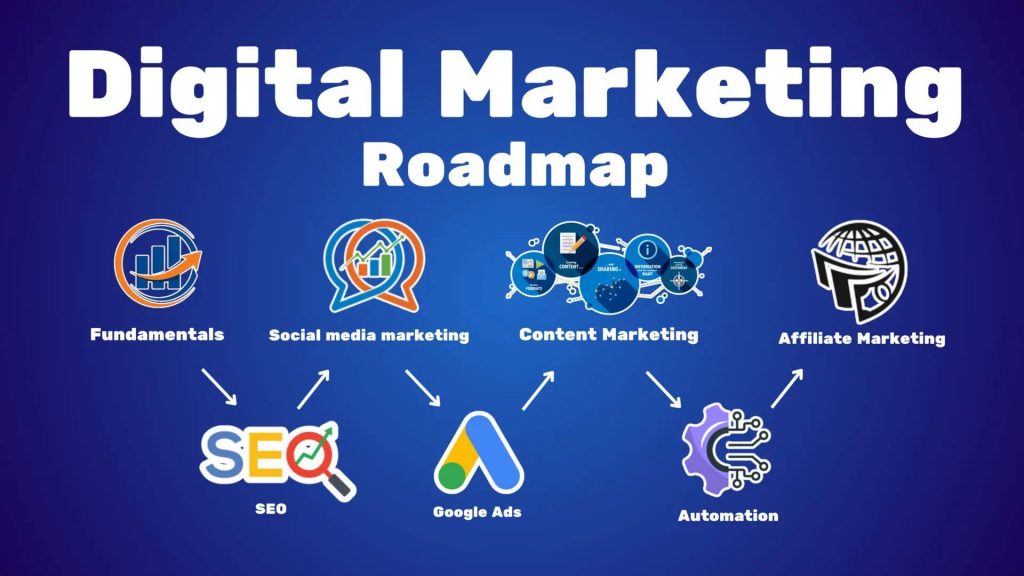
Roadmap Overview — All 12 Stages
Before the detailed stage explanations, here is the complete roadmap at a glance:
| Stage | Timeline | What You Learn | Mini Project |
| 1 — Fundamentals | Week 1–2 | DM channels, funnels, business models | List 10 businesses and their DM strategy |
| 2 — Website | Week 2–3 | WordPress, domains, landing pages, UX | Build a 5-page business website |
| 3 — SEO | Week 3–6 | Keyword research, on-page, technical, AEO, GEO | Optimise a website for 5 target keywords |
| 4 — Google Ads | Week 6–8 | Search, PMax, conversion tracking, bidding | Run a test campaign with INR 500–1,000 budget |
| 5 — Social Media | Week 8–10 | Instagram, LinkedIn, YouTube, content strategy | 30-day social calendar with 30 post ideas |
| 6 — Content Mktg | Week 10–11 | Blogging, topic clusters, AI-assisted content | Write 1 pillar article + 3 cluster articles |
| 7 — Email + Auto | Week 11–12 | Campaigns, segmentation, drip, WhatsApp | Build a 5-email welcome sequence |
| 8 — Analytics | Week 12–13 | GA4, GTM, Looker Studio, conversions | Connect GA4 + GSC + Looker Studio dashboard |
| 9 — AI Tools | Week 13–14 | ChatGPT, Claude, Gemini, prompt engineering | AI content workflow for SEO + social + email |
| 10 — Projects | Week 14–16 | Full campaign integration across channels | Complete portfolio with 3–4 documented projects |
| 11 — Certifications | Week 15–17 | Google Ads, GA4, Meta, HubSpot certifications | Earn minimum 4 recognised certifications |
| 12 — Career Prep | Week 17–18 | Resume, LinkedIn, portfolio, interview prep | Apply for 5 roles or pitch 3 freelance clients |
Stage 1 — Digital Marketing Fundamentals (Week 1–2)
Before learning any tool or channel, understand the underlying principles: what digital marketing is, how customers make decisions, what different business models need from marketing, and how the major channels differ.
What to Learn
- What is digital marketing — channels, objectives, how it differs from traditional marketing
- The marketing funnel — awareness, interest, consideration, conversion, retention, advocacy
- Customer journey mapping — how someone goes from not knowing you exist to becoming a loyal customer
- Digital marketing channels overview — SEO, paid ads, social media, email, content, affiliate, AI marketing
- B2B vs B2C marketing differences — what each type needs from digital channels
- Business goals and how marketing objectives connect to them — not ‘get more likes’, but ‘generate 50 qualified leads per month at INR 400 CPL’
Learning Outcome
At the end of Stage 1, you should be able to: explain what digital marketing is and its main channels, describe the customer journey for a specific business type, and explain why a business would use SEO versus Google Ads versus social media for different objectives.
Mini Project
Choose 3 businesses you interact with regularly — a local shop, an app you use and a brand you follow on social media. For each one, identify which digital marketing channels they appear to be using, what their business objective seems to be, and whether their digital marketing appears to be working. Write 1–2 paragraphs per business. This exercise trains your eye to see marketing strategy in the real world rather than in textbook examples.
Start with the basics — Digital Marketing for Beginners.
Stage 2 — Website Fundamentals (Week 2–3)
Digital marketing activity ultimately connects to a website — ads drive to landing pages, SEO ranks website pages, email links to product pages. Understanding how websites work is not optional knowledge; it is the foundation for everything that follows.
What to Learn
- Domains and hosting — what they are, how they connect, how to set up a basic website
- WordPress basics — install, page creation, plugin management, basic theme customisation
- Basic HTML and CSS — not coding fluency, but the ability to identify tags, understand page structure and make minor edits
- Landing page structure — what makes a landing page convert: headline, value proposition, social proof, CTA
- Website UX basics — navigation, page hierarchy, mobile responsiveness, readability
- Page speed — why it matters (for both SEO and conversion), how to check it (PageSpeed Insights), what causes slowness
Mini Project
Create a 5-page business website for a hypothetical local business — Home, About, Services, Blog, Contact. Install GA4 (you will configure it properly in Stage 8, but install it now so data starts collecting). This website becomes your SEO practice ground in Stage 3.
Stage 3 — Master SEO (Week 3–6)
SEO is the longest stage in this roadmap because it is the most complex and the most foundational. Good SEO knowledge also makes you better at content marketing, Google Ads and understanding your audience — the mental models transfer across channels.
What to Learn
- Keyword research — search volume, keyword difficulty, search intent (informational vs commercial vs navigational)
- On-page SEO — title tags, meta descriptions, header structure, content quality, image alt text, internal linking
- Technical SEO — crawlability, XML sitemap, robots.txt, Core Web Vitals, canonical tags, redirects
- Off-page SEO — backlinks, what makes a quality link, how to earn them, brand mentions
- Local SEO — Google Business Profile, local citations, review management, local pack ranking factors
- E-E-A-T — what it is, why Google uses it, how content demonstrates it
- AI SEO — structuring content for Google AI Overviews and AI Mode
- AEO — Answer Engine Optimisation — FAQ schema, direct answers, topical authority for AI-generated answers
- GEO — Generative Engine Optimisation — content factors that improve AI tool citation rates
Tools to Learn
- Google Search Console — linking to your website, reading performance data, identifying issues
- Google Keyword Planner — free keyword research from Google’s data
- Semrush or Ahrefs free tier — keyword research, competitor analysis, backlink checking
- Screaming Frog (free up to 500 URLs) — technical site crawl
Mini Project
Take the website you built in Stage 2. Identify 5 keywords relevant to that hypothetical business. Optimise each of the 5 pages for one target keyword each — proper title tag, meta description, H1, content with keyword naturally included, image alt text. Set up Google Search Console and submit your sitemap. Document your starting position for each keyword in a spreadsheet — you will track changes over the following weeks.
Specialise in SEO — SEO Course
Stage 4 — Learn Google Ads (Week 6–8)
Google Ads extends your understanding of search intent into paid territory and introduces the discipline of measurable ROI. Every decision in Google Ads is testable and the results are immediate — making it an excellent environment for developing analytical thinking.
What to Learn
- Campaign types — Search, Display, Shopping, YouTube, Performance Max
- Keyword match types — broad match, phrase match, exact match — and their practical effects
- Ad structure — campaigns, ad groups, ads, extensions
- Quality Score — how it is calculated and why it affects cost and position
- Ad Rank — the formula and what it means practically
- Bidding strategies — manual CPC, Smart Bidding (Target CPA, Target ROAS, Maximise Conversions)
- Performance Max — what it is, how to configure asset groups, what inputs it needs to work
- Conversion tracking — setting up conversion actions in Google Ads linked to GA4
- Negative keywords — what they are, why they matter, how to build and maintain a list
Mini Project
Create a Google Ads account (Google provides INR 2,000 free credit for new accounts in India). Set up a simple search campaign for your practice business from Stage 2. Target 5–10 keywords, write 3 responsive search ad headlines and 2 descriptions, set a daily budget of INR 50–100. Run for one week, download the search terms report, add negatives from irrelevant queries, and write a short analysis of what you observed.
Master Google Ads — Google Ads Course
Stage 5 — Social Media Marketing (Week 8–10)
Social media marketing requires a different mindset from search — instead of capturing demand that exists, you are creating attention and building community. Understanding what works on each platform, why it works, and how to measure it separates strategic social media practitioners from those who just post content and hope.
What to Learn
- Instagram — Reels for organic reach, Stories for engagement, Feed for brand identity, algorithm factors
- LinkedIn — personal brand posts versus company page, B2B lead generation, engagement patterns
- YouTube — search SEO for YouTube, video format best practices, description optimisation, Shorts
- Facebook — Business Suite, organic reach limitations, Groups for community building
- X (Twitter) — real-time conversation, personal brand in specific industries
- Platform analytics — reading native analytics on each platform, understanding reach vs engagement vs conversion
- Content calendar — planning content types across platforms by format, objective and timing
Mini Project
Choose one platform to focus on (Instagram or LinkedIn recommended for most learners). Develop a 30-day content calendar with 30 post ideas covering different content types: educational, behind-the-scenes, customer story, opinion, how-to. Write captions for 10 of those posts. Track what type of content gets the highest engagement in your first 2 weeks of publishing.
Stage 6 — Content Marketing (Week 10–11)
Content marketing is the practice of creating systematically useful content that builds authority over time. In 2026, it integrates with SEO through topic clusters, with AI through production workflows, and with every other channel as the material that social media, email and ads distribute.
What to Learn
- Topic clusters and pillar pages — how to structure content for topical authority
- Keyword-driven content planning — how to select topics that rank and convert
- Content calendar discipline — sustainable publishing schedules rather than burst-and-stop
- AI-assisted content workflows — using ChatGPT, Claude or Gemini to draft; adding human expertise, examples and originality in editing
- Video scripting — structuring short and long-form video content for YouTube and social
- Copywriting principles — headlines, body copy, CTAs — writing that moves readers to action
Mini Project
Choose one topic related to your practice website. Write a pillar article of 1,500–2,000 words covering the topic comprehensively. Then write 3 cluster articles of 700–900 words each on specific subtopics. Internal link all cluster articles to the pillar and the pillar to each cluster article. Use an AI tool to generate the initial outline and first draft — then edit extensively, adding your own examples and ensuring the content is genuinely useful rather than generic.
Stage 7 — Email Marketing and Automation (Week 11–12)
Email marketing is consistently the highest-ROI digital marketing channel, and automation makes it work at scale without proportional increases in effort. Understanding how to build subscriber relationships, segment effectively and configure automation sequences is a skill that pays back immediately in any business context.
What to Learn
- Email campaign types — newsletters, promotional emails, transactional emails, re-engagement
- List building — opt-in forms, lead magnets, landing page sign-up flows
- Segmentation — dividing a list by behaviour, purchase history, engagement level
- Automation sequences — welcome drips, abandoned cart flows, post-purchase nurture
- Email metrics — open rate, click rate, unsubscribe rate, bounce rate, deliverability
- A/B testing — subject lines, send times, content variations
- WhatsApp automation — basic WATI or similar setup for Indian market applications
Mini Project
Using MailerLite or Brevo (free tiers are sufficient), create a 5-email welcome sequence for someone who signs up for a hypothetical free resource from your practice website. Email 1: welcome and deliver the resource. Email 2 (2 days later): introduce a related concept. Email 3 (4 days later): address a common question or objection. Email 4 (7 days later): a practical tip. Email 5 (10 days later): invite to take the next step. Configure the automation so each email sends automatically after the trigger.
Stage 8 — Analytics and Tracking (Week 12–13)
Analytics is the skill that transforms marketing from activity into evidence. Without proper tracking, you cannot know which efforts are producing results, which budget is being wasted and what to improve. In 2026, GA4 proficiency is a baseline expectation for most digital marketing roles.
What to Learn
- GA4 setup — data streams, event tracking, user properties, GA4 vs Universal Analytics differences
- Google Tag Manager — what it is, how it works, implementing GA4 events and conversion tracking through GTM
- Google Search Console — connecting to GA4, reading performance data, indexing reports
- Conversion events — defining what a conversion is for your business and configuring it in GA4
- GA4 Explorations — funnel analysis, path analysis, segment overlap reports
- Looker Studio — connecting GA4, Google Ads and Search Console into a single shared dashboard
- Attribution — last-click, data-driven, how to choose and interpret attribution models
Mini Project
Connect GA4, Google Search Console and your Google Ads account. Build a Looker Studio dashboard that shows: website sessions by source/medium this month vs last month; top 5 pages by sessions; Search Console queries with impressions over 100; Google Ads cost vs conversions. This dashboard becomes a template you will customise for future client or employer reporting.
Stage 9 — AI for Digital Marketing (Week 13–14)
AI tools are now expected as standard workflow components in professional digital marketing. This stage focuses on practical AI integration — not theory about AI, but how to use specific AI tools to produce more in less time while maintaining quality.
ChatGPT
Primary applications in your marketing workflow: drafting blog outlines and first drafts, generating ad copy variations, writing email subject line options, brainstorming content ideas, creating content briefs, and generating social media captions for multiple platforms from a single brief. The skill is prompting specifically — vague prompts produce generic output; specific prompts specifying audience, format, tone, length and context produce useful drafts.
Claude
Best suited to: editing AI drafts into natural, high-quality content; processing longer documents (competitor articles, research papers, client briefs) through its large context window; and producing long-form content that reads naturally and meets E-E-A-T standards. Many professionals use ChatGPT to draft quickly and Claude to refine quality.
Gemini
Google’s AI tool — useful for research that benefits from Google ecosystem integration and access to real-time data. Use Gemini when your research requires current information or when the query benefits from Google’s search knowledge.
Perplexity
AI-powered research with source citations. Use Perplexity when you need statistics or factual claims with verifiable sources — it returns cited answers rather than uncited AI generations. Essential for research-backed content where accuracy is important.
NotebookLM
Google’s document analysis tool — upload research papers, competitor articles, client documents and ask questions about them. The AI answers only from your uploaded sources, making it reliable for working with specific documents. Useful for synthesising multiple sources into a content brief or analysis.
Responsible AI Usage Guidelines
- Always edit AI output before publishing — treat every AI draft as a starting point, not a finished product
- Fact-check every statistic AI produces — AI invents numbers confidently; verify from original sources
- Add your own expertise and examples — E-E-A-T requires genuine human knowledge that AI cannot supply
- Never share sensitive client data with public AI tools — your clients’ business information is confidential
- Disclose AI assistance where required — some publishers and employers require disclosure
Learn about AI in digital marketing — AI in Digital Marketing
Stage 10 — Build Real Projects (Week 14–16)
This stage is where skills become evidence. Projects turn what you have learned into the documented results that employers ask to see and clients use to make decisions. A portfolio without documented real projects is just a certificate collection.
Recommended Portfolio Projects
- SEO Audit — conduct a full technical and on-page audit of a real website; document findings and recommendations
- Google Ads Campaign — set up, run and optimise a real search campaign with real (even small) budget and conversion tracking
- Blog Strategy + Execution — publish a pillar article and 2–3 cluster articles; track their Search Console performance over 8 weeks
- Social Media Campaign — plan and execute a 30-day content programme; document reach, engagement and any enquiries generated
- Landing Page — design and build a conversion-focused landing page; test it with a small Google Ads budget; document conversion rate
- Analytics Dashboard — build a Looker Studio dashboard for a real or practice business; document what each metric shows and why it matters
- Email Automation — configure a welcome sequence or drip campaign; document open rates and click rates after 4 weeks
- Local SEO Plan — optimise a Google Business Profile; document changes to local search visibility over 6 weeks
What Employers Expect in a Portfolio
Portfolio work should be specific, measurable and explained in business terms. Do not just say ‘I worked on SEO’. Say: ‘I optimised 8 pages of a coaching institute website targeting keywords like ‘digital marketing course Chandigarh’ — organic sessions to those pages grew from 12 per week to 87 per week over 10 weeks, and we received 4 course enquiries from organic traffic in month 3.’
Stage 11 — Certifications
Certifications validate your knowledge for hiring processes and demonstrate that you take the field seriously. They are most valuable when combined with practical experience — a certification you can answer specific follow-up questions about is valuable; one you cannot is not.
Certifications to Earn
- Google Ads Search Certified (Google Skillshop) — free, directly relevant for any role involving paid search
- Google Analytics GA4 Certified (Google Skillshop) — free, expected at entry level for almost all digital marketing roles
- Meta Certified Digital Marketing Associate (Meta Blueprint) — free, relevant for social media and Meta Ads roles
- HubSpot Content Marketing (HubSpot Academy) — free, valued for content and inbound roles
- HubSpot Email Marketing (HubSpot Academy) — free, relevant for email and automation positions
- Semrush SEO Toolkit Certified (Semrush Academy) — free, demonstrates tool proficiency for SEO roles
When Certifications Help and When Experience Matters More
Certifications are most valuable at entry level — they signal commitment and platform knowledge when practical experience is limited. At experienced levels (3+ years), employers care more about what results you have achieved than which certificates you hold. A practitioner who reduced cost per lead by 35% in a Google Ads campaign will be hired over one with five certifications but no documented results. Do not spend months collecting certifications — develop skills alongside certifications, starting with the platforms you plan to specialise in.
Is digital marketing right for your career? — Is Digital Marketing a Good Career?
Stage 12 — Career Preparation
Resume
Digital marketing resumes work best when they are results-focused rather than task-focused. Compare: ‘Managed social media accounts for the company’ (task) versus ‘Grew Instagram organic reach by 62% in 4 months through consistent Reels publishing strategy’ (result). Every bullet point should either quantify an outcome or specify a skill level that is testable.
LinkedIn Profile
Complete every section: professional headline that specifies your specialisation (not just ‘Digital Marketing Professional’), About section with your career story and what you bring, Skills section with the tools you actually know, and project work with screenshots or descriptions. The most important section for visibility is your headline — it is what recruiter searches surface. ‘SEO Executive | Google Ads | GA4 | 1313 DMI Trained’ is searchable and specific.
Portfolio
A Google Drive folder with documented project results, screenshots and a brief explanation of each is the minimum. A personal website with case studies is more impressive but not always necessary at entry level. What matters: specific metrics, before-and-after comparisons, and your explanation of what you did and what it achieved.
Freelancing Profiles
Upwork and LinkedIn are the two most accessible starting points for Indian digital marketers seeking international freelance work. Upwork requires a complete profile, a specific service description (not ‘I do everything’) and an initial strategy for submitting proposals — first projects at competitive rates to build reviews, then increasing rates as reputation develops. LinkedIn for direct B2B client outreach.
Interview Preparation
Prepare 3 specific examples of work you have done with measurable outcomes. Know your strongest channel deeply — be ready for technical follow-up questions. Practice explaining GA4 reports and campaign performance to someone non-technical. Have 2–3 questions ready to ask the interviewer about the role, the team and what success looks like in 90 days.
Full interview preparation guide — Digital Marketing Interview Questions
Career Paths After Completing the Roadmap
After completing this digital marketing roadmap, multiple career paths are available based on your strongest skills, preferences and goals:
| Career Path | Key Skills Needed | Entry Salary | Growth Path |
| SEO Specialist | Keyword research, technical SEO, AEO, GEO | INR 2–3.5 LPA | Senior SEO > SEO Manager > Head of SEO |
| Google Ads / PPC | Search, PMax, Smart Bidding, GA4 | INR 2.5–4 LPA | PPC Specialist > Performance Mktg Manager |
| Performance Marketer | Google + Meta Ads, ROAS, attribution | INR 3–5 LPA | PM Manager > Head of Performance |
| Social Media Manager | Platform strategy, content, analytics | INR 2–3.5 LPA | Senior SMM > Social Media Head |
| Content Marketer | SEO writing, topic clusters, AI content | INR 2–3.5 LPA | Content Strategist > Content Director |
| Analytics Specialist | GA4, GTM, Looker Studio, attribution | INR 2.5–4 LPA | Analytics Manager > Marketing Data Lead |
| AI Marketing Specialist | ChatGPT/Claude/Gemini, GEO, automation | INR 4–7 LPA | AI Mktg Lead > Marketing Technology Head |
| DM Manager | All channels, team management, reporting | INR 8–14 LPA | DM Director > VP Marketing |
| Freelancer | 2–3 deep skills, client management | INR 15,000–1L+/mo | Solo > Small Agency > Consulting |
See career details — Career in Digital Marketing
Common Roadmap Mistakes to Avoid
| Common Roadmap Mistake | How to Avoid It |
| Learning everything at once | Follow stages in sequence — each builds on the previous. Jumping to Google Ads before understanding how search works produces shallow knowledge. |
| Ignoring fundamentals | Stage 1 is foundational — marketing psychology, buyer journeys and channel logic underpin everything else. Skip it and every channel feels disconnected. |
| No practice — studying without doing | Every stage in this roadmap has a mini project for a reason. Reading about SEO is not the same as doing keyword research on a real website. |
| Using AI content without editing | AI-generated content that is published without editing, fact-checking and adding real expertise fails Google’s E-E-A-T evaluation and teaches you nothing. |
| Skipping analytics | Without GA4 and conversion tracking, you cannot measure what you do. Skipping analytics means every campaign decision is guesswork. |
| Not building a portfolio | Employers and clients ask ‘show me what you have done’. A list of courses without documented results does not answer that question. |
| Giving up after a difficult week | Digital marketing has a steep learning curve in weeks 3–6 (SEO) and 7–8 (Google Ads). This is normal — difficulty is the signal that you are learning something that distinguishes you from others. |
| Comparing your pace to others | Everyone’s starting point and available time differs. A student with 6 hours daily learns faster than a professional with 1 hour. Compare your current self to your previous self. |
90-Day and 180-Day Learning Plans
90-Day Beginner Plan
This plan assumes 3–4 hours of focused learning and practice per day. Outcomes are measured by what you can do, not what you have studied.
| Week | What You Learn | Project / Practice | Milestone |
| 1–2 | DM fundamentals, marketing basics, channels overview | Analyse 5 businesses — which DM channels do they use? | Can explain digital marketing and its main channels confidently |
| 3 | Website, domains, hosting, WordPress | Launch a 5-page website on WordPress | Working website live with GA4 installed |
| 4–6 | SEO — keyword research, on-page, technical, AEO basics | Optimise website for 5 target keywords | At least 3 pages fully on-page optimised; Search Console connected |
| 7–8 | Google Ads — search campaigns, match types, PMax basics | Create and run a test search campaign | Campaign live with conversion tracking; understand Quality Score |
| 9–10 | Social media — Instagram, LinkedIn, YouTube basics | 30-day content calendar; publish 8 social posts | Content calendar complete; engagement metrics tracked |
| 11 | Content marketing — blogging, topic clusters, AI content | Write 1 pillar article; use AI for content brief and first draft | Published article with keyword targeting; internal links set up |
| 12 | Email marketing basics + GA4 analytics setup | 5-email welcome sequence; GA4 exploration report | Email sequence built; GA4 and Google Ads connected |
180-Day Professional Plan
This plan extends the 90-day foundation into deep specialisation, professional credentials and career launch. Weeks 13–24 build on the foundation and assume continued learning of 2–3 hours per day.
| Week | What You Learn / Deepen | Key Deliverable | Career Milestone |
| 1–12 | Complete 90-day plan above | All 90-day milestones achieved | Foundation in all major channels |
| 13–14 | AI tools deep dive — ChatGPT, Claude, Gemini workflows; AEO and GEO practice | AI content workflow operational; AEO schema on 5 pages | Can demonstrate AI-assisted production to employers |
| 15–16 | Deep specialisation in 1–2 channels (e.g., SEO + Performance) | Second website SEO audit; PMax campaign analysis | Documented results in 2 specialisations |
| 17 | Certifications — Google Ads Search, GA4, Meta Blueprint, HubSpot | 4 certifications earned | Certification portfolio complete |
| 18–20 | Freelance client acquisition — profile, pitch, first client | First paid client project or internship confirmed | Professional experience documented |
| 21–22 | Portfolio and resume — 3–4 documented projects with metrics | Portfolio website or PDF deck with case studies | Portfolio ready for interviews |
| 23–24 | Interview preparation, LinkedIn optimisation, applications | 10 job applications sent or 5 client pitches made | Interviews booked or first client retainer secured |
Both plans assume active learning with practical projects — not passive video watching. A person who watches 4 hours of tutorials daily without practising will be less prepared at week 12 than someone who spends 2 hours learning and 2 hours practising on a real website or campaign.
Frequently Asked Questions
How long does it take to complete the digital marketing roadmap?
The 12-stage digital marketing roadmap takes 16–18 weeks with 3–5 hours of daily dedicated learning and practice. At 1–2 hours per day (part-time alongside work or study), the same content takes 5–7 months. Rushing through stages without completing the mini projects produces knowledge without the practical skills that actually matter in employment and freelancing.
Do I need any qualifications to start this digital marketing roadmap?
No specific qualifications are needed. Digital marketing is one of the few professional fields where educational background is largely irrelevant to entry-level hiring. What matters is demonstrated practical skill — which you develop through the roadmap projects — and the ability to show results, which you document in your portfolio.
Which stage should I start with if I already have some digital marketing knowledge?
Honestly evaluate your actual skill level rather than your familiarity with concepts. If you have studied SEO but have never optimised a real website with measurable results, start from Stage 3 and do the project properly. If you can demonstrate GA4 knowledge — not just that you know what GA4 is, but that you can build Explorations and configure conversion events — skip Stage 8. The honest self-assessment is the most important part of adapting the roadmap to your starting point.
Is it necessary to complete all 12 stages?
For anyone pursuing employment or professional freelancing, yes — completing all stages gives you the broad foundation that makes you adaptable and the specific depth in one or two areas that makes you hireable. For business owners, Stages 1, 3, 4 and 8 deliver the most practical value if time is the constraint. For specialists deepening an existing skill, focus on the stages most relevant to your chosen specialisation.
What mini projects should I prioritise for my portfolio?
The three highest-impact portfolio projects for most roles are: an SEO project with documented organic traffic improvement (even modest improvement on a practice site), a Google Ads campaign with documented conversion tracking and CPL achieved, and a Looker Studio analytics dashboard that shows you can connect and present data. These three together demonstrate the skills most consistently tested in digital marketing interviews.
What is AEO and why is it in the SEO stage?
AEO stands for Answer Engine Optimisation — structuring content to appear in AI-generated answers, including Google AI Overviews, voice assistant responses and AI chatbot answers. It is included in Stage 3 because it is now part of practical SEO rather than a separate discipline. Content structured for AEO — direct answers early, FAQ schema markup, topical authority — also performs better in traditional search results.
How important are certifications in the digital marketing roadmap?
Certifications are stage 11 in this roadmap — important but not foundational. Earn them alongside developing practical skills (particularly Google Ads Search and GA4 while you are actively learning those channels), but do not delay applying for roles or pitching clients until you have collected more certificates. Demonstrated results from projects outperform certificates in most hiring decisions.
Should I choose one specialisation or learn everything?
During the roadmap, learn everything to a functional level. After completing the roadmap, specialise in one to two channels for employment or freelancing purposes. The field is too broad to maintain expertise in all areas simultaneously. The specialists who earn the most are those with genuine depth in performance marketing, web analytics, AI marketing or SEO — not generalists who know a little about many channels.
How do I use AI tools responsibly in the digital marketing roadmap?
Use AI as a productivity tool, not as a learning shortcut. The point of Stage 9 in this roadmap is to integrate AI into workflows you already understand — not to use AI to skip learning the fundamentals. If you use AI to write your Stage 3 SEO project content without understanding how to do keyword research yourself, you have not learned SEO; you have used AI to appear to complete a project. AI should accelerate what you already know, not replace the learning.
What tools do I need to follow this digital marketing roadmap?
The roadmap uses primarily free tools: Google Search Console (free), GA4 (free), Google Tag Manager (free), Google Ads (free account, small budget for practice), Google Keyword Planner (free), Canva free tier (design), ChatGPT or Claude free tier (AI), MailerLite free tier (email), WordPress.com free or own hosting at INR 100–200/month. Total cost for the complete roadmap: INR 1,200–2,500 for hosting and practice ad spend plus the course fee if you use structured training.
What salary can I expect after completing this digital marketing roadmap?
Entry-level salaries after completing this roadmap and building a portfolio range from INR 2–3.5 LPA for general digital marketing executive roles to INR 3–5 LPA for specialisations like Google Ads or analytics in cities like Chandigarh, Mohali and Patiala. Delhi NCR and Bangalore start higher at INR 3–7 LPA for equivalent roles. Freelancing income varies widely but typically starts at INR 15,000–25,000 per month from 2–3 small clients and grows substantially with demonstrated results and international client access.
Can I complete this roadmap while working full-time?
Yes, but the timeline extends significantly. At 1.5–2 hours per day, the same 12 stages take 5–6 months rather than 16–18 weeks. The key is consistency — 1.5 hours daily outperforms 5 hours on weekends because regular practice builds and retains skills faster than infrequent intense sessions. The most important accommodation for full-time learners: do not skip the projects. Reduced learning hours can be managed, but projects cannot be skipped without reducing practical skill development.
Is it better to follow this roadmap self-study or through a training programme?
Self-study with online resources is possible for motivated learners with strong self-direction. Structured training through a programme like 1313 DMI provides: guided sequencing, live client campaign access (which personal projects cannot replicate), instructor feedback on projects, and accountability. The primary advantage of structured training is access to real campaign data from actual businesses — the gap between optimising your own practice website and managing a real client’s campaign with a real budget is significant and takes much longer to bridge through self-study.
What is the difference between this roadmap and a digital marketing degree?
This roadmap is skills-based and practical — every stage has a project and produces demonstrable ability. Digital marketing degrees are typically broader in academic scope but slower and less practically oriented. The roadmap produces someone who can do the work in 16–18 weeks; a degree takes 3 years. Most digital marketing employers in India assess practical ability through interview demonstration and portfolio work rather than degree credentials. The roadmap is a more direct path to employment in most cases.
How do I find my first client or job after completing the roadmap?
For employment: apply before you feel fully ready — by the end of Stage 12 you have the skills for entry-level roles. A profile on Naukri and LinkedIn with your projects listed will generate recruiter inquiries for anyone with a complete profile and certifications. For freelancing: your first client is usually someone you know — a local business, a friend’s startup, a cause you are involved in. Offer to handle one specific channel (Local SEO or Google Ads) at a discounted rate in exchange for a documented case study.
Conclusion
The digital marketing roadmap described in this guide is not a theoretical framework — it is the practical sequence that produces genuinely job-ready practitioners when followed consistently. Every stage builds on the previous one. Every mini project produces evidence. Every milestone gives you something specific to demonstrate in an interview or client conversation.
The most important element of the roadmap is not which course you take or which tools you use — it is consistent practice on real digital properties with real (even if small) budgets. The gap between someone who followed this roadmap diligently for 18 weeks with 3–4 hours of daily practice and someone who studied casually for the same period is enormous — and directly visible in the quality of their portfolio and interview answers.
In 2026, AI tools accelerate the productivity of practitioners who already understand what they are doing. They do not replace the need to understand how search works, how audiences think, how campaigns are measured or what good strategy looks like. The roadmap equips you with that understanding — AI tools are then the tools that help you apply it more efficiently.
Start with Stage 1 this week. Follow the sequence. Do every project. Document every result. By week 18, you will have more practical, documented digital marketing experience than most candidates who have been collecting certificates for two years.
Follow This Roadmap with Structured Live Campaign Training
1313 Digital Marketing Institute (1313 DMI) — the training division of Solutions1313 — provides this roadmap as a structured learning environment where students train on real client campaigns. Training is available in Chandigarh, Mohali and Patiala.
Related Guides:
- What is Digital Marketing?
- Digital Marketing Salary in India
- How to Learn Digital Marketing?
- Types of Digital Marketing
- Digital Marketing Skills
- Digital Marketing Tools
- Benefits of Digital Marketing
- Digital Marketing Jobs
- Future of Digital Marketing
- Digital Marketing Strategy
- Digital Marketing Trends
- Digital Marketing Course in Chandigarh
- Digital Marketing Course in Mohali
- Digital Marketing Course in Patiala
You can reach us at-
Phone: +91 92160 41313 | +91 93331 41313
Email: admin@solutions1313.com
Chandigarh: SCO 60-62, 2nd Floor, Sector 17-C
Mohali HQ: SCO 54, 2nd Floor, Sector 82, JLPL, Airport Road
Patiala: #44 B.N. Khalsa School Complex, Sirhind Road
Book a Free Demo Class — Call +91 92160 41313 | admin@solutions1313.com
