
Most people have heard of digital marketing. Fewer people understand that it is not one thing — it is a collection of 13 or more distinct channels, each with its own techniques, tools, timelines and ideal use cases. A business that uses only social media is not doing digital marketing; it is doing one type of digital marketing.
This guide explains every major type of digital marketing in practical terms: what each channel is, how it works, when to use it, and what its strengths and limitations are. Whether you are a student learning the field, a business owner trying to decide where to invest, or a professional looking for a structured overview, this is designed to give you a complete picture.
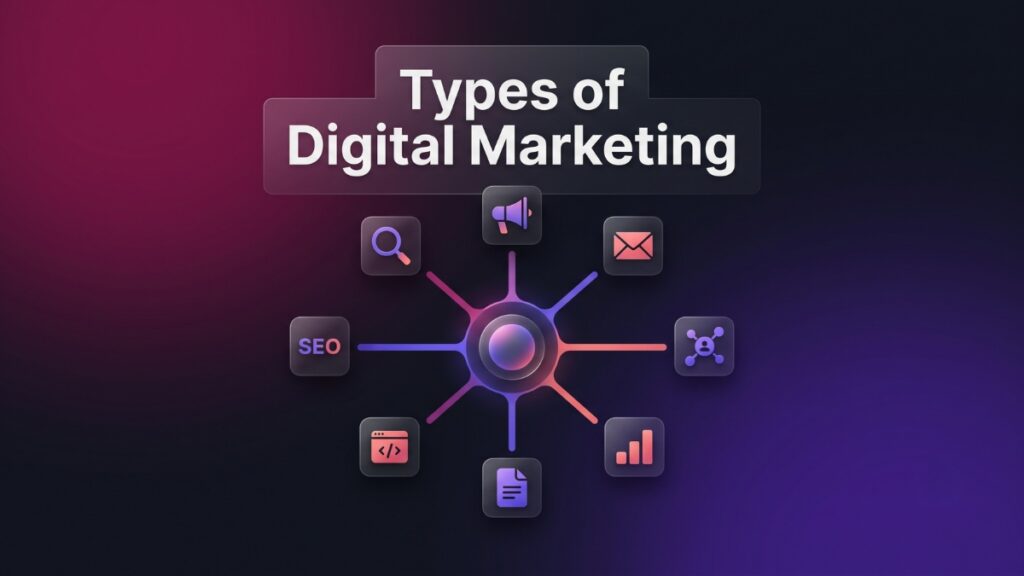
Quick answer: The main types of digital marketing are SEO, Google Ads (PPC), social media marketing, Meta Ads, content marketing, email marketing, affiliate marketing, influencer marketing, video marketing, mobile marketing, local SEO, performance marketing and AI marketing. Most successful businesses use a combination of several.
What Are the Types of Digital Marketing?
Digital marketing refers to all marketing activities that use digital channels — the internet, search engines, social media, email, mobile apps, and AI-powered platforms — to reach, attract and convert potential customers.
The term covers a spectrum from organic (free to run, slow to build, long-lasting) to paid (immediate visibility, stops when you stop paying), and from direct-response (someone takes immediate action) to brand building (accumulates trust over time). Here is a quick overview before the detailed explanations:
- SEO — Organic visibility in search engines
- Google Ads — Paid advertising across Google’s network
- Social Media Marketing — Organic brand presence on platforms
- Meta Ads — Paid advertising on Facebook and Instagram
- Content Marketing — Creating useful content that attracts an audience
- Email Marketing — Direct communication with subscribers
- Affiliate Marketing — Commission-based partner promotion
- Influencer Marketing — Paid partnerships with content creators
- Video Marketing — YouTube, Reels, Shorts, OTT
- Mobile Marketing — SMS, push notifications, WhatsApp, apps
- Local SEO — Visibility in local map and ‘near me’ searches
- Performance Marketing — Paid channels tied to specific business outcomes
- AI Marketing — Using AI tools to power and optimise all of the above
New to digital marketing? Start here — Digital Marketing for Beginners
Why Businesses Use Multiple Digital Marketing Channels?
No single type of digital marketing does everything well. A business that relies only on SEO has no immediate way to reach customers during the months it takes to build organic rankings. A business that uses only paid ads has no sustainable traffic if the budget runs out. An e-commerce brand that only posts on Instagram reaches only the fraction of its target audience that uses Instagram — and only the fraction of those users who happen to see a particular post.
The most effective digital marketing strategies combine channels in ways that complement each other. SEO and content marketing build long-term organic visibility. Google Ads captures high-intent searches immediately. Email marketing converts interested leads and retains existing customers. Social media builds community and awareness. Each channel plays a different role in the customer journey from stranger to buyer to loyal advocate.
For beginners, the practical implication is this: learn all the types well enough to understand what each one does, then develop depth in two or three based on your goals and your clients’ businesses.
SEO — Search Engine Optimisation
SEO is the practice of improving a website’s visibility in organic (non-paid) search results on Google and other search engines. When someone searches for ‘digital marketing course in Chandigarh’ and your website appears on the first page without a paid ad, that is the result of SEO.
SEO is the highest-ROI digital marketing channel for most businesses over the long term. A page that ranks well on Google continues delivering traffic for years with ongoing (but moderate) maintenance. The catch is that it takes time — typically 3 to 6 months before significant organic traffic develops, and longer for competitive keywords.
Types of SEO
| Type of SEO | What It Covers | Example Task |
| On-Page SEO | Title tags, meta descriptions, content quality, headers, internal links | Rewriting a page title to include the target keyword naturally |
| Off-Page SEO | Backlinks from other sites, brand mentions, digital PR | Getting a news article to link back to your website |
| Technical SEO | Site speed, mobile responsiveness, crawlability, structured data | Fixing a slow-loading page that Google cannot index properly |
| Local SEO | Google Business Profile, local citations, map rankings | Optimising GBP so a Patiala dentist appears for ‘dentist near me’ |
| AI SEO | Content structured for AI Overviews, AEO, GEO, schema markup | Writing FAQ sections that appear in Google’s AI-generated answers |
How Google’s AI Has Changed SEO in 2026
Google’s AI Overviews now appear at the top of many search results, synthesising answers from multiple sources. For SEO practitioners, this changes content strategy: content that is clearly structured, directly answers specific questions, and demonstrates genuine expertise is more likely to be included in AI Overviews. This discipline is called AEO (Answer Engine Optimisation) when focused specifically on AI-generated answer formats.
When to Use SEO?
- Any business that wants sustainable organic traffic without continuous ad spend
- Businesses in markets where potential customers actively search for what they offer
- Blogs, informational websites and educational content providers
- Local businesses wanting to appear in local search results
Pros and Cons
- Pro: Long-term compounding value — a strong article or page keeps working for years
- Pro: Free traffic — no cost per click once ranking is established
- Pro: High trust — people trust organic results more than paid ads
- Con: Slow — meaningful results take months
- Con: Algorithm dependency — major updates can affect rankings unpredictably
- Con: Requires ongoing effort — content, links and technical maintenance
Learn SEO in depth — SEO Course
Google Ads — Paid Search and Paid Advertising
Google Ads is the paid advertising platform run by Google. Unlike SEO, which earns position through content quality and authority, Google Ads buys position — you bid for the right to appear at the top of search results, across websites in Google’s Display Network, on YouTube, in Google Shopping, and across all of Google’s properties through Performance Max.
Google Search Ads
Search ads appear at the top and bottom of Google search results pages, marked ‘Sponsored’. You choose keywords to bid on, write ad copy and set a budget. You pay only when someone clicks (Pay-Per-Click, or PPC). Search ads are particularly effective for capturing high-intent queries — when someone searches ‘digital marketing course fee in Mohali’, they are close to making a decision. Being present at that moment is valuable.
Google Display Ads
Display ads are image or banner-based advertisements that appear across millions of websites and apps that are part of Google’s Display Network. Unlike search ads (which show to people actively looking for something), display ads reach people based on their interests, demographics or browsing behaviour. They are better for brand awareness than direct conversion.
Google Shopping Ads
Shopping ads show product images, prices and store names in search results when someone searches for a product. Essential for e-commerce businesses. Managed through Google Merchant Center, which requires a product feed listing your inventory with accurate descriptions and prices.
YouTube Ads
Video advertisements that appear before or during YouTube videos. Formats include skippable in-stream ads, non-skippable ads, and bumper ads. YouTube advertising is effective for brand awareness and for reaching specific audience segments through YouTube’s targeting capabilities.
Performance Max
Performance Max (PMax) is Google’s AI-powered campaign type that runs across all Google properties simultaneously — Search, Display, YouTube, Gmail, Maps and Discover. You provide asset groups (headlines, descriptions, images, videos) and Google’s algorithm decides how to combine and deliver them for maximum conversion performance. It requires strong conversion tracking through GA4 to work effectively.
When to Use Google Ads?
- When you need leads or sales immediately — organic takes months, ads are immediate
- For high-intent searches — ‘buy running shoes online’ vs generic ‘running shoes’
- For new business launches before organic presence has been built
- For seasonal promotions where timing is critical
Pros and Cons
- Pro: Immediate results — ads can go live within hours
- Pro: Precise targeting by keyword, location, device, audience
- Pro: Scalable — increase budget when campaigns are profitable
- Con: Ongoing cost — traffic stops when budget stops
- Con: Increasing competition and costs in many industries
- Con: Requires technical knowledge to configure correctly — especially PMax and Smart Bidding
Master Google Ads with live training — Google Ads Course
Social Media Marketing
Social media marketing uses platforms like Instagram, Facebook, LinkedIn, YouTube, X (Twitter) and others to build a brand presence, create community and distribute content organically — that is, without paying for advertising. It is distinct from Meta Ads (paid) and requires a different skill set and approach.
India’s most visually-active platform. Effective for consumer brands, D2C products, fashion, food, travel, lifestyle and education. The algorithm rewards content that generates genuine engagement — saves and shares in particular. Reels (short-form video) currently receive the strongest organic reach on the platform.
Largest platform by user count in India, with a broad demographic. More useful for community groups, local business pages and longer-form content than Instagram. Organic reach for pages has declined significantly over the years — Facebook’s value for most businesses now sits primarily in Meta Ads (paid).
The most valuable platform for B2B marketing, professional services, recruitment and thought leadership. Content posted by individuals consistently reaches further than brand page content. LinkedIn is where a consultant, trainer or SaaS company builds professional credibility and generates B2B leads organically.
X (Twitter)
Real-time platform suited to news, commentary, industry conversations and personal brand building. Less effective for direct lead generation but useful for networking within specific industries and for businesses where real-time engagement is relevant.
Visual discovery platform particularly effective for products in home decor, fashion, food, weddings, crafts and DIY. Users on Pinterest often have high purchase intent — they are actively looking for ideas and products. Important for e-commerce brands in these categories.
Snapchat
Primarily used by younger demographics (16–25). More relevant for brands targeting Gen Z audiences with short-form content, stories and AR features. Snapchat Ads have grown as an advertising option but organic presence requires consistent short-form video content.
When to Use Social Media Marketing?
- Building brand awareness and community over time
- Consumer brands where visual content and storytelling drive purchase decisions
- Professionals and consultants building personal brand and thought leadership
- Businesses wanting to be reachable and responsive on platforms their customers use
Meta Ads — Facebook and Instagram Advertising
Meta Ads is the paid advertising system for Facebook and Instagram, managed through Meta Ads Manager. Unlike Google Ads (which targets people based on what they are searching for), Meta Ads target people based on who they are — their interests, demographics, behaviours and connections.
Campaign Types
Meta Ads campaigns are built around objectives: Awareness (reach as many relevant people as possible), Traffic (send people to your website), Engagement (get likes, comments, shares), Leads (collect lead information through Meta’s native forms or a landing page), and Sales (generate purchases directly, often used with Meta’s product catalogue for e-commerce).
Advantage+ Campaigns
Meta’s AI-driven campaign system, introduced after iOS 14 changed the ad data landscape. Advantage+ Audience removes manual audience selection — you provide your creative assets and let Meta’s algorithm find the best audience automatically. Advantage+ Shopping Campaigns do the same for e-commerce. In 2026, most Meta campaigns perform better with Advantage+ targeting than with granular manual audience selection.
Retargeting on Meta
The Retargeting shows ads to people who have already interacted with your business — visited your website, watched a video, engaged with your page, or abandoned a cart. Retargeting consistently outperforms cold audience targeting in conversion rate because you are reaching people who already know you. Requires Meta Pixel or Meta Conversions API for accurate tracking.
Lead Generation Ads
Meta’s Lead Ads collect contact information (name, phone, email) through a form that opens within the Meta app — without the user needing to visit a website. Popular for service businesses, education providers and financial services. Lower friction than directing to an external landing page.
Pros and Cons
- Pro: Detailed audience targeting — age, location, interest, income, behaviour
- Pro: Large reach — Facebook and Instagram have massive Indian user bases
- Pro: Visual formats (Reels, Carousels, Stories) support diverse creative approaches
- Con: Attribution challenges — iOS 14 limits the reliability of click-based reporting
- Con: Creative fatigue — audiences become desensitised to the same ads quickly
- Con: Requires ongoing creative refresh — not a ‘set and forget’ channel
Content Marketing
Content marketing is the strategy of creating and distributing useful, relevant content to attract and engage a specific audience — with the aim of building trust, authority and long-term relationships that eventually lead to commercial outcomes.
The key word is ‘useful’. Content marketing is not about creating promotional material that talks about your products. It is about creating the blog article that answers the question your potential customer is already asking, the guide that helps them solve a problem, the case study that shows how your approach worked for someone similar to them.
Blogs and Articles
Written content published on your website, designed to rank in search results and provide genuine value to readers. Blog content that consistently addresses the questions your target audience asks builds topical authority — Google’s recognition that your website is a credible source on a specific subject.
Guides and Whitepapers
Long-form content that provides comprehensive coverage of a specific topic. Guides are valuable for generating email sign-ups (gated content), demonstrating expertise, and ranking for detailed informational queries. Whitepapers are more common in B2B contexts — in-depth research or analysis that supports a sales conversation.
Case Studies
Documented examples of how your product or service helped a specific client or customer. Particularly valuable in B2B sales and for high-consideration purchases where potential buyers want evidence that your approach works. A well-written case study — specific about the problem, the approach taken and the measurable outcome — is one of the most persuasive pieces of content you can create.
Video Content
Video has moved from supplementary to central in content strategy. YouTube is the second-largest search engine in the world. Short-form video through Instagram Reels, YouTube Shorts and similar formats reaches the largest organic audiences on those platforms. Video content serves both awareness (wide reach) and education (demonstrating expertise) depending on format and placement.
Infographics and Visual Content
Data visualisations, process diagrams and illustrated explanations that make complex information scannable and shareable. Effective for social media distribution, as supporting assets in blog content, and in email newsletters.
Podcasts
Audio content that builds relationship with an audience through consistent, in-depth conversation. Podcasts suit businesses whose audiences consume content while commuting, exercising or doing other activities. India’s podcast listener base is growing steadily, particularly for business, self-improvement and finance content.
Pros and Cons
- Pro: Compounds over time — content published today keeps attracting traffic for years
- Pro: Builds genuine trust and authority — harder to fake than paid visibility
- Pro: Serves multiple channels — a good article becomes a social post, email, video script
- Con: Slow — content marketing results are rarely immediate
- Con: Requires consistent investment — irregular content has much lower impact
- Con: Quality matters enormously — low-quality content can harm rather than help
Email Marketing
Email marketing involves sending emails to a list of people who have subscribed, purchased or otherwise given you permission to communicate with them. It is consistently among the highest-ROI digital marketing channels because you are communicating directly with people who already have a relationship with your brand.
Newsletters
Regular emails sent to subscribers with valuable content, company updates, product information or curated industry news. A well-written newsletter builds the habit of recipients opening your emails — which increases the effectiveness of every subsequent send.
Marketing Automation and Drip Campaigns
Automated sequences of emails triggered by specific actions — signing up for a free guide, making a first purchase, or abandoning a cart. A drip campaign gradually moves someone from ‘mildly interested’ to ‘ready to buy’ through a series of relevant, timed emails. The automation runs without ongoing manual effort once configured correctly.
Lead Nurturing
Email sequences designed to educate and build relationship with leads who are not yet ready to buy. Common in B2B and high-consideration purchase contexts where the buying cycle is long. A coaching centre might nurture a prospective student through 6–8 emails over 3 weeks before that student is ready to enrol.
Transactional Emails
Automated emails triggered by specific events — order confirmations, booking receipts, password resets, shipping updates. High open rates because recipients are expecting them. Transactional emails are also a branding opportunity — the experience of receiving a well-designed, clear confirmation email is part of the customer relationship.
Pros and Cons
- Pro: Very low cost — sending to a large list costs very little per email
- Pro: Owned channel — no algorithm controls your reach to your own subscribers
- Pro: High intent audience — subscribers chose to hear from you
- Con: Requires list building — starting from zero is slow
- Con: Deliverability issues if lists are not maintained — spam complaints hurt sender reputation
- Con: Unsubscribe risk — poorly written or too-frequent emails drive people away
Affiliate Marketing
Affiliate marketing is a performance-based arrangement where a business pays a commission to partners (affiliates) who drive traffic or sales. The affiliate promotes the product through their own channels — a blog, YouTube channel, social media account or email list — and earns a percentage of each sale they generate.
For businesses, affiliate marketing is a relatively low-risk customer acquisition channel: you pay only when a sale occurs. For affiliates, it is a way to monetise existing audiences without creating products of their own.
In India, affiliate marketing is particularly active in categories like financial products (credit cards, loans, insurance), e-commerce (Amazon Associates, Flipkart Affiliate), hosting and domain services, and digital education. A personal finance blogger who recommends a particular credit card and earns INR 500–2,000 per approved application is a common model.
Pros and Cons
- Pro: Pay-per-performance — cost only incurred when a sale occurs
- Pro: Scales without proportionally increasing marketing overhead
- Con: Limited creative control over how affiliates represent your brand
- Con: Fraud risk — requires careful tracking and partner vetting
- Con: Building a strong affiliate programme takes time and active management
Influencer Marketing
Influencer marketing uses individuals with established audiences — on Instagram, YouTube, LinkedIn, podcasts or other platforms — to promote a brand’s products or services. Influencers are trusted by their followers in ways that traditional advertising rarely achieves, which is why their recommendations can drive significant purchasing behaviour.
In India, influencer marketing spans nano influencers (1,000–10,000 followers, high engagement, niche audiences), micro influencers (10,000–100,000 followers), macro influencers (100,000–1 million) and mega influencers or celebrities (1 million+). The general pattern is that smaller influencers have higher engagement rates and more trusting audiences; larger ones offer wider reach but lower engagement proportion.
What Makes Influencer Marketing Effective?
The effectiveness of influencer marketing depends less on follower count and more on audience relevance and genuine trust. An influencer with 50,000 highly engaged followers in a specific niche — say, home improvement in North India — can drive better commercial outcomes for a hardware brand than a celebrity with 5 million followers whose audience is diverse and not particularly engaged.
Compliance and ASCI
India’s Advertising Standards Council of India (ASCI) requires that paid influencer content be clearly disclosed. Posts that are paid promotions must be labelled as such. Many Indian brands and influencers still fall short of this requirement — which creates legal risk and reputational risk if undisclosed paid content is later identified.
Pros and Cons
- Pro: Authentic endorsement from a trusted source within a specific community
- Pro: Reach into audiences that traditional or paid media might not access
- Con: Difficult to measure ROI accurately without proper tracking
- Con: Creator quality and brand alignment requires careful vetting
- Con: One-off campaigns have limited long-term value — sustained partnerships work better
Video Marketing
Video has become the dominant content format across digital channels. More people watch video online than any other content type. In India, mobile video consumption is particularly high — YouTube is among the most-used apps in the country, and Instagram Reels drives enormous organic reach for brands that produce video consistently.
YouTube
The second-largest search engine in the world. YouTube is effective for both brand awareness (broad reach) and education (targeted searches for ‘how to’ content). Videos that answer specific questions — ‘how to start a Google Ads campaign’, ‘what is the best digital marketing course in Chandigarh’ — rank in YouTube search and sometimes in Google search results as well. Long-form YouTube content builds deeper audience relationships than short-form.
YouTube Shorts and Instagram Reels
Short-form video (60 seconds or under) receives the highest organic reach on both YouTube and Instagram. The algorithm actively distributes Shorts and Reels to new audiences, making them effective for brand discovery. Consistent short-form video posting has helped small accounts in India grow audiences that took much longer to build through traditional posting.
OTT Advertising
Over-the-top platforms (Hotstar, JioCinema, Netflix, Amazon Prime Video) offer advertising options that reach audiences watching long-form video content on connected TVs, smartphones and tablets. OTT advertising in India is growing significantly with the shift from traditional TV to streaming platforms.
Pros and Cons
- Pro: Highest engagement of any content format — people watch longer and remember more
- Pro: YouTube SEO creates long-term discovery through search
- Pro: Short-form video drives organic reach faster than most other formats
- Con: Production requirements — even ‘casual’ looking videos require planning and editing
- Con: Long-form video has a higher time investment for both creator and viewer
Mobile Marketing
Mobile marketing covers all marketing activities specifically designed for mobile devices — smartphones and tablets. Given that over 80% of digital interactions in India happen on mobile, mobile marketing is less a separate discipline and more the standard context for almost all digital marketing. However, certain channels and techniques are specifically mobile-first.
SMS Marketing
Text message marketing. High open rates (90%+ in most studies) because SMS messages are typically read within minutes of receipt. Common for appointment reminders, promotional offers, order updates and time-sensitive notifications. Regulatory compliance (DND lists, consent requirements) is critical for SMS campaigns in India.
Push Notifications
Notifications delivered through mobile apps or web browsers. Appear on a user’s phone or desktop without the user being inside the app. Effective for re-engaging users who have installed an app or subscribed to push alerts. Require explicit permission to send.
WhatsApp Marketing
WhatsApp is one of the most-used communication channels in India. The WhatsApp Business allows businesses to communicate with customers through broadcast lists, catalogue sharing, automated responses and official WhatsApp Business API (for larger-scale communications). Personal and direct, WhatsApp marketing typically has very high engagement rates when used with genuine permission and relevance.
Mobile App Marketing
If a business has a mobile app, driving downloads and in-app engagement is its own marketing discipline — involving app store optimisation (ASO), in-app messaging, push notifications, deep linking and user retention campaigns.
Pros and Cons
- Pro: Immediate reach — SMS and push notifications are read within minutes
- Pro: WhatsApp in India has near-universal reach across demographics
- Con: Permission-dependent — aggressive outreach without consent damages brand trust
- Con: Over-notification causes users to revoke permissions or uninstall apps
Local SEO
Local SEO is the practice of optimising a business’s online presence for location-based searches — when someone adds ‘near me’, a city name, or ‘in [area]’ to their search, or when Google infers local intent from the query. For businesses that serve customers in a specific geographic area, Local SEO is often the highest-value digital marketing investment.
Google Business Profile
Google Business Profile (GBP) is the most important tool in local SEO. It is the listing that appears in Google Maps and in the ‘map pack’ — the group of three businesses shown with a map at the top of local search results. A fully optimised GBP profile, with accurate information, photos, regular posts and strong review ratings, significantly improves local search visibility.
Local Citations
Citations are mentions of your business name, address and phone number (NAP) on other websites — directories, review sites, local news, industry associations. Consistent NAP information across multiple citation sources strengthens Google’s confidence in your business information and improves local ranking.
Review Management
Google reviews are a major ranking factor for local SEO and a significant influence on customer decision-making. A Chandigarh restaurant with 4.6 stars and 400 reviews will consistently outperform a competitor with 3.8 stars in local results. Actively generating reviews from satisfied customers and professionally responding to negative ones is an important part of local SEO.
When to Use Local SEO
- Any business serving customers who are physically located in a specific area
- Healthcare, dental, legal, hospitality, food and beverage, retail, education
- Service businesses (plumbers, electricians, contractors, salons)
- Any business wanting to appear for ‘near me’ searches in their category
Pros and Cons
- Pro: High-intent traffic — local searches often indicate near-term purchase intent
- Pro: Competitive advantage for businesses who invest — many local businesses still have weak GBP
- Con: Google can change local algorithm factors and ranking fluctuates
Performance Marketing
Performance marketing is a discipline within paid digital marketing where the advertiser pays based on specific, measurable outcomes rather than for impressions or clicks alone. The defining characteristic is accountability to business results: you track whether the money spent actually generated leads, sales or revenue.
Key Performance Marketing Metrics
ROAS (Return on Ad Spend): How much revenue was generated for every rupee spent on advertising. A ROAS of 4 means INR 4 revenue for every INR 1 spent on ads.
CPA (Cost Per Acquisition): How much it cost to acquire one customer. If you spent INR 10,000 on Google Ads and acquired 20 customers, your CPA is INR 500.
CPL (Cost Per Lead): How much it cost to generate one lead (enquiry, sign-up, or form submission). Important for businesses where the sale happens offline after initial contact.
Attribution
Attribution is the process of crediting specific marketing touchpoints for conversions. When a customer discovers you through SEO, sees a retargeting ad, clicks a Google search ad and then converts — which of those interactions gets credit for the sale? Multi-touch attribution models attempt to distribute credit across multiple touchpoints. In 2026, attribution is becoming more complex as iOS privacy changes and cookie deprecation affect cross-platform tracking.
Performance Marketing vs General Digital Marketing
All marketing ideally tracks performance. What distinguishes ‘performance marketing’ as a specific discipline is the design of campaigns from the outset around measurable conversion goals — not awareness or engagement as intermediate metrics, but leads and revenue as the primary success measure.
Pros and Cons
- Pro: Directly accountable to revenue — clearest ROI of any marketing type
- Pro: Scalable — increase budget when campaigns are profitable, decrease when not
- Con: Requires proper conversion tracking and attribution setup — complex to do correctly
- Con: Can create short-term thinking that underinvests in brand building
How to Learn Digital Marketing for a Successful Career
AI Marketing
AI marketing is not a single channel — it is the application of artificial intelligence tools and techniques across all of the types of digital marketing described above. In 2026, AI has become embedded in how campaigns are optimised, how content is produced and how marketing data is analysed.
AI Tools in Marketing Practice
ChatGPT
Used for content drafts, ad copy variations, email subject line testing, keyword brainstorming, and customer response templates. The most widely used AI writing tool in marketing, with both free and paid (GPT-4) versions.
Claude
Particularly useful for editing and refining content — making AI drafts sound natural, improving long-form coherence and producing content that meets E-E-A-T standards. Used by content strategists as a quality improvement tool.
Gemini
Google’s AI tool, increasingly integrated with Google’s marketing products. Useful for research, content creation that connects to current data, and tasks within Google’s ecosystem.
Perplexity
An AI-powered research tool that provides cited answers — combining AI synthesis with sourced references. Useful for keeping current with algorithm changes, competitor research and finding statistics with verifiable sources.
AI SEO
AI SEO involves optimising content for AI-powered search features. Google’s AI Overviews synthesise answers from multiple sources at the top of search results. Content that is clearly structured, specifically answers the query and demonstrates expertise is more likely to be featured. This requires structured content with proper heading hierarchy, direct-answer formatting and schema markup.
AEO — Answer Engine Optimisation
AEO is the practice of structuring content to appear in AI-generated answers — featured snippets, voice search responses, and AI chatbot answers from ChatGPT, Gemini or Perplexity. It involves FAQ-format content, schema markup (FAQ, HowTo, Speakable), and writing that answers specific questions directly and early in the content.
GEO — Generative Engine Optimisation
GEO focuses on improving the likelihood that generative AI tools cite or recommend your content when answering relevant queries. Research from 2024 identified content factors associated with higher AI citation: sourced statistics, expert quotations, clear definitions and comprehensive coverage from an identifiable authoritative source. GEO is emerging as a distinct practice within digital marketing.
Marketing Automation with AI
AI-powered marketing automation delivers personalised content and communications at scale — dynamically personalised email subject lines based on individual behaviour, AI-driven product recommendations, chatbots that qualify leads before human follow-up, and predictive lead scoring that identifies which prospects are most likely to convert. These capabilities, once available only to enterprise-scale businesses, are becoming accessible to mid-sized businesses through affordable SaaS platforms.
Pros and Cons
- Pro: Significant productivity gains — AI tools allow one person to produce more than an entire team previously could
- Pro: New specialisations (GEO, AEO, AI workflow design) command premium rates
- Pro: AI-optimised campaigns (PMax, Advantage+) outperform manually managed equivalents when set up correctly
- Con: Requires human judgment to use well — AI output needs editing, fact-checking and contextualising
- Con: Rapidly evolving — what works today may need updating as tools and platforms change
AI in Digital Marketing: Tools, Trends, and Benefits
Comparison — All Digital Marketing Channels
This table compares all major types of digital marketing across five key dimensions. Use it as a planning reference when deciding which channels to prioritise.
| Channel | Cost | ROI | Speed | Difficulty | Long-term Value | Best For |
| SEO | Low/Med | High | Slow (3–6m) | Medium | Very High | All businesses |
| Google Ads | Med/High | High | Immediate | Medium | Medium | Lead gen, sales |
| Meta Ads | Low/Med | Medium | 1–3 days | Medium | Medium | Awareness, D2C |
| Content Mktg | Low | High | 3–6 months | Medium | Very High | Authority building |
| Social Media | Low | Medium | 1–2 months | Low | Medium | Brand, community |
| Email Mktg | Very Low | Very High | Immediate | Low | High | Retention, nurture |
| Local SEO | Low | High | 1–3 months | Low | High | Local businesses |
| Affiliate | Low | High | Variable | Low | Medium | E-commerce |
| Influencer | Med/High | Medium | 1–2 weeks | Medium | Low–Med | Awareness, D2C |
| Video Mktg | Low/Med | High | 1–3 months | Medium | High | Brand, education |
| Performance | High | Very High | Immediate | High | Medium | Revenue-tied |
| AI Marketing | Low | High | Immediate | Medium | Very High | Efficiency gains |
‘Cost’ refers to budget required to run the channel effectively (not learning cost). ‘Speed’ is time to meaningful results. ‘Long-term value’ refers to whether results persist without continuous spend.
Which Type of Digital Marketing is Best for Your Business?
The ‘best’ type depends entirely on who you are, who your customers are, and what you want to achieve. Here is a practical guide:
| Who You Are | Best Starting Channels | Why |
| Student / Fresher | SEO, Content, Google Ads (basics) | Build portfolio, learn fundamentals, get hired faster |
| Local Business | Local SEO, Google Ads (local), WhatsApp | Reach nearby customers actively searching for you |
| E-commerce Business | Google Shopping, Meta Ads, Email, SEO | Reach buyers at every funnel stage — discover, consider, buy again |
| B2B Company | LinkedIn Ads, SEO, Content Marketing, Email | Longer sales cycles need trust-building channels |
| Startup | SEO, Performance Marketing, Social Media | Growth-focused, measurable, flexible as strategy evolves |
| D2C Brand | Meta Ads, Influencer, Email, Video | Visual products, community building, repeat purchase |
| Freelancer | SEO, Content (personal brand), LinkedIn | Build visibility, attract clients, demonstrate expertise |
Two principles apply across all of these categories. First, most businesses need at least two or three channels working together — one for immediate traffic (paid ads), one for long-term organic growth (SEO or content), and one for retention (email or WhatsApp). Second, the channels that work best are the ones you have the skills and consistency to execute well — a well-run social media account beats a poorly managed Google Ads campaign every time.
Learn all major digital marketing channels — Digital Marketing Course in Chandigarh
Common Mistakes When Using Digital Marketing Channels
These are the mistakes that waste budget, delay results and cause businesses to conclude that digital marketing ‘does not work’ — when the real issue is how it was being done:
| Common Mistake | What to Do Instead |
| Using all channels at once with no strategy | Start with 2–3 channels that match your business type and budget |
| Measuring social media likes instead of business outcomes | Track leads, sales and cost per acquisition — not follower counts |
| Running paid ads without conversion tracking | Set up GA4 and conversion goals before spending any budget |
| Ignoring email marketing for a large subscriber list | Email ROI exceeds most paid channels when used with good segmentation |
| Treating SEO as one-time work | SEO needs consistent content, link building and technical maintenance |
| Using influencers purely by follower count | Engagement rate and audience relevance matter far more than size |
| Not using AI tools in content or ad workflows | AI tools are now standard — avoiding them creates a productivity gap |
| Copying competitors’ strategy without context | Competitor success in one channel does not mean it works for your audience |
Future of Digital Marketing Channels
AI Will Be Embedded in Every Channel
AI is no longer a separate type of digital marketing — it is becoming infrastructure within every channel. Google Ads already uses AI for bidding (Smart Bidding) and campaign delivery (Performance Max). Meta Ads uses AI for audience targeting (Advantage+). Content production uses AI tools. Local SEO involves AI Overviews. By 2028–2030, working effectively with AI will not be a distinguishing skill — it will be an assumed baseline.
Search Will Become More Conversational
Google’s AI Mode and similar features are moving search toward conversational, multi-step interactions rather than single queries returning a list of links. This will require SEO and content practitioners to think in terms of conversations and intent journeys rather than individual keywords.
First-Party Data Will Define Competitive Advantage
As third-party cookies phase out and privacy regulations strengthen, businesses with strong first-party data — email lists, CRM databases, app user data, loyalty programme data — will have significant advantages in personalisation and retargeting. Email marketing and permission-based mobile marketing become more rather than less valuable as this shift progresses.
Short-Form Video Will Remain Dominant
Instagram Reels, YouTube Shorts and similar formats have established short-form vertical video as the dominant organic content format. This trend is structural, not cyclical — it reflects how people consume content on mobile, not a temporary platform preference.
Voice and Visual Search
Voice search through AI assistants and visual search through Google Lens are both growing. For digital marketing practitioners, this means optimising for conversational queries, local intent (voice search often has strong local intent), and product image quality (visual search relies on clean, descriptive product imagery).
Future of Digital Marketing: Trends to Watch
Frequently Asked Questions
What are the main types of digital marketing?
The main types of digital marketing are SEO (Search Engine Optimisation), Google Ads (PPC), social media marketing, Meta Ads, content marketing, email marketing, affiliate marketing, influencer marketing, video marketing, mobile marketing, local SEO, performance marketing and AI marketing. Most businesses use a combination of several of these types rather than relying on a single channel.
Which type of digital marketing is best for beginners?
SEO is the best starting point for beginners. It teaches you how search works, how content quality is evaluated, and how to structure information for online discovery — mental models that apply to every other channel. Google Ads is a strong second choice because it teaches measurable accountability and search intent. Together they form the foundation for most digital marketing careers. See our guide at /digital-marketing-for-beginners.
What is the difference between SEO and Google Ads?
SEO is organic — you earn your position in search results through content quality and website authority. There is no cost per click, but it takes 3–6 months to build. Google Ads is paid — you bid for position and pay each time someone clicks. It delivers immediate results but stops when you stop paying. Most businesses need both: Google Ads for immediate traffic, SEO for long-term sustainable visibility.
What are Meta Ads?
Meta Ads are paid advertisements that run on Facebook and Instagram, managed through Meta Ads Manager. They target people based on who they are (interests, demographics, behaviour) rather than what they are searching for. Meta Ads are effective for brand awareness, D2C product sales, lead generation and retargeting people who have already visited your website.
What is performance marketing?
Performance marketing is paid digital marketing where you pay based on specific, measurable outcomes — cost per lead (CPL), cost per acquisition (CPA), or return on ad spend (ROAS). Unlike brand awareness campaigns that pay for reach, performance marketing campaigns are evaluated entirely on whether they generate the specific business outcome they were designed for.
What is AEO in digital marketing?
AEO stands for Answer Engine Optimisation — the practice of structuring content to appear in AI-generated answer formats, featured snippets, voice assistant responses, and AI chatbot answers. As AI tools like ChatGPT, Gemini and Perplexity handle more search queries, content that clearly and directly answers specific questions is more likely to be surfaced in those answers.
What is GEO in digital marketing?
GEO stands for Generative Engine Optimisation — improving the likelihood that AI tools like ChatGPT, Claude, Gemini and Perplexity cite or recommend your content when answering relevant queries. Content associated with higher AI citation rates tends to include sourced statistics, expert quotations, clear definitions and comprehensive topic coverage from an identifiable source.
What is Local SEO and who needs it?
Local SEO optimises a business’s online presence for location-based searches — ‘dentist near me’, ‘digital marketing course in Patiala’, ‘restaurant in Sector 17 Chandigarh’. Any business that serves customers in a specific geographic area needs local SEO. The Google Business Profile is the central tool — a fully optimised GBP significantly improves visibility in local map results.
What is content marketing?
Content marketing is creating and distributing useful content — articles, videos, guides, case studies, podcasts — that helps your target audience rather than directly selling to them. The logic: consistent helpfulness builds trust, and trusted brands are chosen first when purchase decisions are made. Content marketing compounds over time — a useful article from three years ago can still attract daily visitors.
How many types of digital marketing should a beginner learn?
A beginner should start by developing solid understanding of 2–3 types before expanding. The recommended starting combination is SEO, Google Ads and analytics (GA4). These three together give you organic visibility, paid visibility and the measurement skills to evaluate both. Once proficient, add social media, email or content marketing based on your career goals or client needs.
What is influencer marketing?
Influencer marketing uses individuals with established audiences on social media platforms to promote a brand’s products or services. The influencer’s authentic voice and trusted relationship with their followers makes the recommendation more persuasive than conventional advertising. Effective influencer marketing is defined by audience relevance and genuine trust, not follower count alone.
Is social media marketing the same as digital marketing?
No. Social media marketing is one type of digital marketing. Digital marketing is a broader category that includes SEO, Google Ads, email, content, paid advertising, affiliate marketing, performance marketing and more. A business that only uses social media is using one channel within a much wider discipline.
What is the most cost-effective type of digital marketing?
Email marketing typically delivers the highest ROI relative to cost because sending emails to an existing list costs very little per message, and subscribers have already expressed interest in your brand. SEO also delivers excellent long-term value once rankings are established. The most cost-effective channel for your specific business depends on your audience and where they are in their buying journey.
What is affiliate marketing in simple terms?
Affiliate marketing is when a business pays a commission to a partner (affiliate) for each customer or sale the partner brings in. The affiliate promotes the business through their own channels — blog, YouTube, social media — and earns a percentage of each completed transaction. It is a pay-for-performance model: the business pays only when results are delivered.
How has AI changed the types of digital marketing?
AI has changed digital marketing in several ways: Google’s AI Overviews and AI Mode have changed how SEO content needs to be structured. Performance Max and Advantage+ have made paid advertising more algorithm-driven. Content production now uses AI tools like ChatGPT, Claude and Gemini as standard workflow components. New disciplines — AEO and GEO — have emerged focused specifically on visibility in AI-generated answers. AI automation enables personalisation at scale previously only available to large enterprises.
The Future of AI in Digital Marketing
Conclusion
The types of digital marketing described in this guide are not competing alternatives — they are complementary tools that serve different stages of the customer journey, different objectives and different timelines. The most effective digital marketing strategies combine organic and paid, short-term and long-term, awareness and conversion.
For beginners, the practical starting point is clear: learn SEO and Google Ads well, develop analytics proficiency through GA4, and start using AI tools from the beginning. The other channels expand naturally from this foundation as you develop specialisation and take on clients or roles that require them.
For businesses, the key question is not which type of digital marketing exists — it is which combination of types makes sense for your specific customers, your specific goals and your specific resources. A local service business in Patiala has very different channel priorities from a D2C e-commerce brand or a SaaS B2B company, even if they all fall under the same broad umbrella of ‘digital marketing’.
Learn All Types of Digital Marketing with Live Campaign Experience
1313 Digital Marketing Institute (1313 DMI) — the training division of Solutions1313 — covers all major types of digital marketing in structured programmes that include real campaign access from the beginning. Based in Chandigarh, Mohali and Patiala since 2009.
Ace Your Interview with Digital Marketing Interview Questions
Related Guides:
- What is Digital Marketing?
- Digital Marketing Jobs
- Benefits of Digital Marketing
- Digital Marketing Strategy
- Career in Digital Marketing
- Digital Marketing Scope in India
- Digital Marketing Salary in India
- Is Digital Marketing a good career?
- Digital Marketing skills
- Digital marketing tools
- Digital Marketing Trends
- Digital marketing Roadmap
- Digital Marketing Course in Mohali
- Digital Marketing Course in Patiala
Get in touch with us-
Phone: +91 92160 41313 | +91 93331 41313
Email: admin@solutions1313.com
Chandigarh: SCO 60-62, 2nd Floor, Sector 17-C
Mohali HQ: SCO 54, 2nd Floor, Sector 82, JLPL, Airport Road
Patiala: #44 B.N. Khalsa School Complex, Sirhind Road
Book a Free Demo Class — Call +91 92160 41313 | admin@solutions1313.com
