

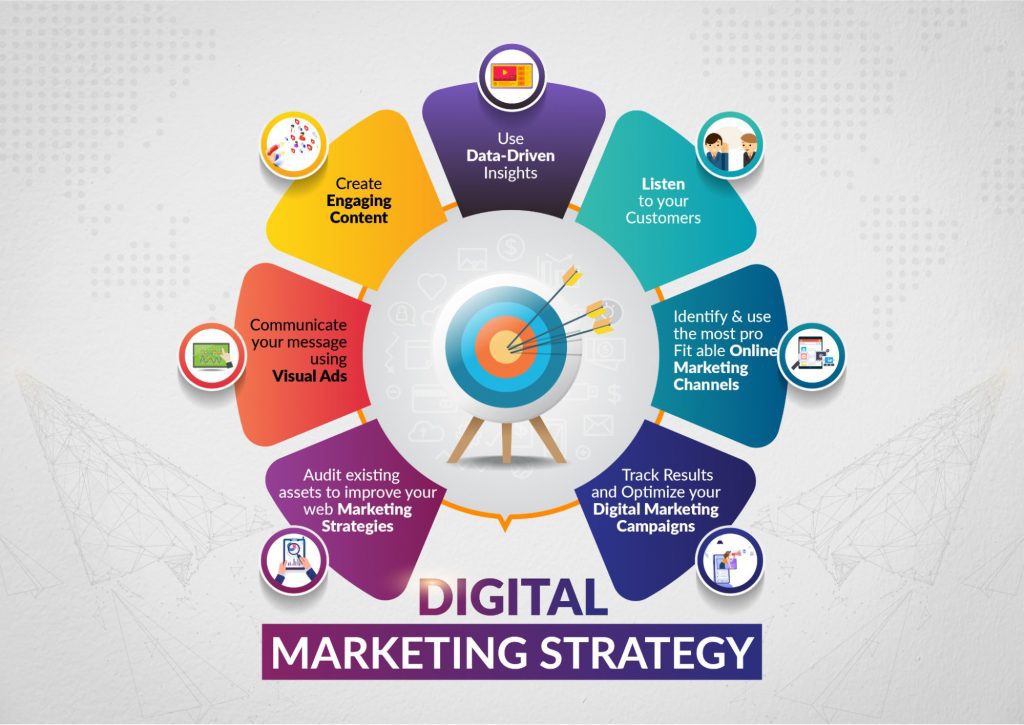
Most businesses that struggle with digital marketing do not have a tools problem, a budget problem or a creativity problem. They have a strategy problem: they are running campaigns, posting content and spending money without a clear plan for how any of it connects to business outcomes.
A digital marketing strategy is the plan that changes that. It defines what you want to achieve, who you are trying to reach, which channels you will use and why, how you will allocate budget, how you will measure success, and how you will improve over time. Without it, even excellent tactical execution produces inconsistent results.
This guide explains how to build a digital marketing strategy that works in 2026 — one that integrates AI where it genuinely helps, uses data for decisions rather than assumptions, and creates a system that produces predictable results rather than occasional wins.
Quick answer: A digital marketing strategy is a documented plan that connects business goals to specific marketing activities across chosen channels. It defines who you are targeting, what channels you will use, what budget you are allocating, what results you are measuring, and how you will optimise over time. It is the difference between running campaigns and running a marketing system.
What is a Digital Marketing Strategy?
Definition
A digital marketing strategy is a structured plan for using online channels to achieve specific business objectives over a defined time period. It connects the business goal (‘increase revenue by 25% in 12 months’) to the marketing objective (‘generate 300 qualified leads per month’) to the specific channel activities that will produce those leads (‘Google Ads for search intent, SEO for long-term organic, email to nurture leads through decision’).
Strategy vs Tactics
Strategy and tactics are often confused, but the distinction matters. Strategy answers the question ‘what are we trying to achieve and how will we approach it?’. Tactics answer ‘what specific actions are we taking to execute that approach?’. Running a Google Ads campaign is a tactic. Deciding that paid search is the right channel for capturing high-intent demand while SEO builds organic authority over 6 months is strategy.
The most common failure mode in digital marketing is having tactics without strategy — running campaigns based on what competitors are doing, what a consultant suggested, or what a salesperson sold, without a clear view of how those activities connect to the business’s actual goals.
Why Every Business Needs One?
Without a documented digital marketing strategy: budget is allocated based on habit rather than evidence; channels are used because they are familiar rather than because they are appropriate; success is measured by vanity metrics (website visits, likes, impressions) rather than business outcomes (leads, revenue, customer lifetime value); and improvements are random rather than systematic.
A strategy is also the document that enables accountability — both for the marketing team and for the business leaders who evaluate their work. It creates a shared understanding of what success looks like and how it will be pursued.
Why a Digital Marketing Strategy Matters?
Business Growth
A well-designed digital marketing strategy creates a system for sustainable growth rather than one-off campaign results. SEO builds organic traffic that compounds over time. Email marketing creates retention that improves customer lifetime value. Performance marketing generates leads at a predictable cost. When these work together, the growth curve steepens over time rather than plateauing.
Lead Generation
For most businesses, the primary commercial objective of digital marketing is a reliable flow of qualified enquiries. A strategy ensures that lead generation is intentional — that the right channels are reaching the right people at the right stage of their decision process, rather than generating undifferentiated traffic that rarely converts.
Brand Awareness
Digital marketing strategy ensures that brand awareness activities serve long-term commercial objectives, not just visibility metrics. Social media presence, content marketing and PR each contribute to awareness that influences purchase decisions — but only when they are targeted at the right audience and consistent in their messaging.
Better ROI
The most direct argument for strategy is return on investment. Businesses with documented digital marketing strategies consistently outperform those running ad-hoc campaigns, because strategy allows budget to be concentrated on what is working and removed from what is not. Measurement, which strategy requires, enables improvement that compounding budget efficiency over time.
Long-Term Scalability
A strategy creates a marketing system that scales. Individual campaigns are not scalable — they require ongoing manual attention to maintain. A strategy that builds SEO authority, email lists, brand recognition and documented playbooks for paid campaigns can be scaled by adding budget and resource to a working system, rather than starting from scratch with each new campaign.
The Next Big Career Move — Is Digital Marketing A Good Career Option in 2026?
Core Components of a Successful Digital Marketing Strategy
Every effective digital marketing strategy contains these foundational elements:
Clear Business Goals
The strategy must start with a business objective that is specific and time-bound. ‘Get more customers’ is not a goal. ‘Increase qualified leads by 40% in 12 months while maintaining current cost per lead’ is a goal that can be built into a strategy, measured and optimised.
Marketing Objectives and KPIs
Marketing objectives translate business goals into measurable marketing targets. If the business goal is revenue growth, the marketing objective might be: generate 250 qualified leads per month at a CPL below INR 800. The KPIs — cost per lead, conversion rate, channel attribution — are what you track monthly to know whether you are on track.
Audience Definition
The strategy must define who the marketing is for — specifically. Generic targeting produces generic results. A buyer persona that is specific about the person’s role, location, concerns, information sources and decision triggers produces marketing that converts at significantly higher rates than broad audience targeting.
Channel Selection
The strategy must specify which channels to use and why — not which channels are popular, but which channels reach your specific audience at the stages of their decision journey. B2B SaaS needs LinkedIn and content marketing. Local services need Local SEO and Google Ads. D2C consumer products need Meta Ads and email. The channel choice flows from the audience, not from the channel’s general reputation.
Budget Allocation
A strategy includes a budget plan that distributes resources across channels based on their role in the strategy: acquisition channels (Google Ads, Meta Ads), authority channels (SEO, content), retention channels (email, WhatsApp) and tool infrastructure (GA4, Semrush, scheduling tools). The allocation changes as channels prove their performance.
Timeline and Roadmap
Strategy requires a timeline that acknowledges different channels’ result timelines. SEO typically shows meaningful results in 3–6 months. Paid advertising produces results from launch. Email marketing is effective immediately for existing lists. A good strategy builds on these timelines — using paid to generate immediate results while organic channels mature.
Technology Stack
The strategy should specify the tools that will support execution and measurement: GA4 for analytics, GTM for tracking, Semrush or Ahrefs for SEO research, an email platform, a CRM, and the AI tools integrated into content and analysis workflows.
Learn the tools every strategy needs — Digital Marketing Tools
Understanding Your Target Audience
The most common cause of ineffective digital marketing strategy is poor audience definition. When you do not know who you are marketing to with precision, everything else in the strategy is guesswork.
Building Buyer Personas
A buyer persona is a detailed, semi-fictional representation of your ideal customer based on real data about your existing customers, market research and informed analysis. A useful persona is specific enough to guide creative decisions: if you are writing a Google Ad headline, you should be able to ask ‘would this specific person click on this?’ and have a meaningful answer.
Example: B2B SaaS Buyer Persona
- Name: Priya, Marketing Manager at a mid-size IT company in Bangalore
- Age: 32, budget authority for INR 5–15 lakh marketing tools
- Pain point: Wasting hours on manual campaign reporting — needs automation
- Information sources: LinkedIn, G2 reviews, Google search, industry newsletters
- Decision trigger: Sees competitor using a tool she hasn’t evaluated; CFO asks for marketing ROI data
Example: Local Service Buyer Persona
- Name: Rahul, 42, homeowner in Sector 22 Chandigarh
- Situation: Pipe leak at home, needs a plumber within 2 hours
- Behaviour: Searches ‘plumber near me’ on mobile, reads 3–5 Google reviews, calls the highest-rated one
- Decision trigger: Visible high Google rating, reviews mentioning quick response, clear phone number
Customer Intent
Search intent is the ‘why’ behind a search query. Someone searching ‘what is digital marketing’ has informational intent — they want to learn. Someone searching ‘digital marketing course fee in Chandigarh’ has commercial intent — they are comparing options before deciding. Someone searching ‘1313 DMI admission’ has navigational intent — they are looking for a specific brand.
Your digital marketing strategy must map content and campaigns to the right intent. Informational content builds awareness and trust. Commercial intent content closes the consideration stage. Navigational searches should make it easy to find you directly. Mismatching content to intent — like putting a sales pitch in a blog post targeting informational queries — consistently underperforms.
The Customer Journey
The customer journey maps the sequence of interactions between a potential customer and your brand, from first awareness to purchase to repeat purchase and advocacy. A digital marketing strategy must ensure the brand is present at every meaningful stage of this journey — not just at the final conversion moment.
Psychographics and Behaviour
Beyond demographics, psychographics — values, beliefs, aspirations, frustrations — and online behaviour patterns determine which messages resonate and which platforms reach your audience. Understanding not just who your customer is but what they care about and where they spend their digital time is what separates marketing that feels relevant from marketing that feels like advertising.
Master in-demand digital marketing skills — Digital Marketing Course in Mohali
Competitor Research and Market Analysis
A digital marketing strategy that ignores the competitive landscape is built without important context. Competitor analysis is not about copying what competitors do — it is about understanding where the opportunities are and where the field is already crowded.
SWOT Analysis
A digital SWOT analysis examines your brand’s Strengths (strong existing email list, good Google reviews, a differentiated product), Weaknesses (poor website, no content, low brand awareness), Opportunities (competitors have weak SEO, new AI-related keywords with low competition, underserved regional market) and Threats (well-funded competitor launching, algorithm change affecting existing traffic). This framework should inform which channels to invest in and which competitive angles to avoid.
Competitor Benchmarking
Competitive analysis tools like Semrush and Ahrefs allow you to see which keywords competitors rank for, where they are getting backlinks, what their traffic sources look like, and what content they are publishing. This data reveals: which keywords you could target where they are weak, which content formats are working in your niche, and what backlink opportunities might be available.
Keyword Gap Analysis
Keyword gap analysis (available in Semrush and Ahrefs) identifies keywords that competitors rank for but you do not. This is one of the most efficient starting points for an SEO content strategy — rather than guessing what content to create, you can identify specific topics where potential customers are finding your competitors and plan content to compete for those searches.
Content Gap Analysis
Content gap analysis identifies topics that your audience is searching for that no competitor has addressed comprehensively. These are opportunities to create the definitive resource on a topic — building authority and ranking for searches that competitors are ignoring.
Google Trends
Google Trends shows search interest for specific topics over time and by geography. For an Indian business, it is particularly useful for identifying regional search patterns, seasonal trends in your category, and whether interest in your topic is growing or declining. A digital marketing strategy built around a declining search trend is starting from a disadvantaged position.
Master Google Ads with AI — Google Ads Course
Choosing the Right Marketing Channels
Channel selection is one of the most important decisions in a digital marketing strategy. The wrong channels waste budget and produce frustration. The right channels connect you efficiently with your specific audience at the right moment.
| Channel | Cost | Speed | Results | Best Use Case | Difficulty |
| SEO | Low | Slow (3–6m) | Long-term | Brand authority, discovery | Medium |
| Google Ads | Med/High | Immediate | Short-term | High-intent leads, launches | Medium |
| Meta Ads | Low/Med | Fast (days) | Short-medium | Awareness, D2C, retargeting | Medium |
| LinkedIn Ads | High | Fast (days) | Short-medium | B2B lead generation | Medium |
| YouTube Ads | Med | Fast | Short-medium | Brand, education, reach | Medium-High |
| Content Mktg | Low | Slow | Long-term | Authority, SEO support | Medium |
| Email Mktg | Very Low | Immediate | Long-term | Nurture, retention | Low |
| Social Media | Low | Medium | Medium | Community, awareness | Low |
| Low | Immediate | Short-term | India-specific follow-up | Low | |
| Local SEO | Low | 1–3 months | Long-term | Location-based businesses | Low-Med |
How to Choose Your Channel Mix?
Channel selection should follow this logic: who is my audience, where are they in their decision journey, and which channel reaches them there?
- High purchase intent + active searching = Google Ads or Local SEO
- Broad awareness + demographic targeting = Meta Ads or YouTube
- Professional audience + B2B purchase = LinkedIn + Content Marketing
- Existing warm leads + retention = Email + WhatsApp
- Long-term authority + compound traffic = SEO + Content Marketing
Most successful digital marketing strategies use at least two complementary channels: one for immediate results (paid) and one for long-term compounding value (organic). A strategy built entirely on paid channels creates dependency and stops working when budget stops. A strategy built entirely on organic channels grows too slowly for most businesses in the short term.
Understand every channel — Types of Digital Marketing
Building a Content Strategy
Content is the fuel of most digital marketing channels — SEO depends on content, email depends on content, social media is content, paid ads need content for creative. A content strategy ensures that content creation is systematic rather than reactive.
Pillar Pages and Topic Clusters
The most effective SEO content structure in 2026 is the topic cluster model. A pillar page is a comprehensive guide to a broad topic (like this guide on digital marketing strategy). Cluster pages are more specific articles on subtopics that link back to the pillar. This structure signals topical authority to Google — demonstrating that your website covers a subject in depth rather than in isolation.
Example: A digital marketing training institute builds a pillar page on ‘digital marketing strategy’, with cluster articles on ‘SEO strategy’, ‘content strategy for beginners’, ‘Google Ads strategy for small businesses’, ’email marketing strategy’ and similar. Each cluster article links to the pillar and to each other, creating a web of authority around the central topic.
Blog Strategy
A blog strategy defines: which topics to cover (based on keyword research and buyer persona questions), what format each piece should take (how-to, listicle, comparison, guide), how frequently to publish (consistency matters more than volume), and how each piece serves the customer journey (awareness, consideration or conversion content).
Video Content Strategy
Video has become central to digital marketing content in 2026. A video content strategy identifies which formats to produce (short-form Reels for awareness, longer YouTube tutorials for education, testimonials for conversion), at what frequency, and with what production level. AI tools have significantly lowered the production threshold for short-form video — CapCut, Descript and similar tools allow one person to produce consistent short-form video without a full production setup.
Content Calendar
A content calendar translates strategy into scheduled execution. It specifies what will be published, on which platform, on which date, in what format, targeting which audience and keyword. It prevents the common pattern of high output during motivated periods and near-zero output during busy ones — the stop-start pattern that prevents content from having a compounding effect.
Content Repurposing
A single well-researched pillar article can generate: a series of shorter LinkedIn posts, an email newsletter, a YouTube video script, several Instagram carousel posts, a podcast episode and a downloadable guide. Repurposing multiplies the reach of content investment without multiplying the research effort. This is where AI tools are particularly useful — drafting social posts, email summaries and video scripts from a single source document.
AI-Powered Digital Marketing Strategy
AI is not an optional addition to a digital marketing strategy in 2026 — it is an expected component that affects content production, campaign optimisation, audience analysis and performance measurement. Here is how AI integrates into each strategic area:
Content Planning with AI
ChatGPT, Claude and Gemini accelerate content research, outline creation and first-draft production. A content strategist who uses AI to draft content briefs, generate keyword cluster ideas and produce first drafts of blog posts can produce 3–4 times the content output in the same time. The human contribution shifts to brief writing, quality editing and ensuring E-E-A-T compliance — expertise, authoritativeness and trustworthiness that AI cannot manufacture.
AI for AEO — Answer Engine Optimisation
Google’s AI Overviews and AI Mode are changing how search results are presented. Content that appears in AI Overviews is typically well-structured, directly answers the query, and demonstrates specific expertise. A digital marketing strategy that includes AEO means: structuring content with FAQ sections and schema markup, providing direct answers early in each piece, and building the topical authority that makes AI systems confident in citing your content.
GEO — Generative Engine Optimisation
GEO is the strategy of making your content more likely to be cited by AI tools like ChatGPT, Gemini, Claude and Perplexity. Research from 2024 identified content factors associated with higher AI citation rates: sourced statistics, expert quotations, clear definitions and comprehensive coverage from an identifiable authoritative source. Including GEO in your digital marketing strategy means systematically applying these content quality factors — which also improves traditional SEO simultaneously.
AI for Campaign Optimisation
Google Ads’ Performance Max and Meta Ads’ Advantage+ use AI for campaign delivery optimisation — allocating budget across ad formats and audiences automatically. A digital marketing strategy that incorporates these tools means: providing the algorithm with high-quality inputs (diverse creative assets, accurate conversion data, strong audience signals) and then evaluating and adjusting based on output, rather than managing at the individual keyword or audience level.
Marketing Automation
AI-powered marketing automation delivers personalised experiences at scale — email sequences that adapt to individual behaviour, chatbot responses that qualify leads, dynamic content that adjusts to user profiles. A digital marketing strategy should identify which customer journey stages benefit most from automation (lead nurturing, post-purchase follow-up, re-engagement of lapsed customers) and configure automation for those stages first.
Where Human Expertise Is Still Essential
AI cannot replace strategic judgment — deciding which channels to prioritise, what positioning will resonate with a specific Indian audience, how to respond when a campaign underperforms, or how to communicate results to a client who is questioning the investment. AI cannot build client relationships or understand the cultural nuances of marketing to specific regional demographics. Creative concepts — the idea before the execution — remain human contributions. The digital marketing strategy should define clearly where AI accelerates execution and where human expertise remains the primary input.
Master AI in Digital Marketing for Better Results
Conversion Funnel Strategy
A digital marketing strategy must plan for every stage of the conversion funnel, not just the final conversion. Customers who are aware of your brand but not yet ready to buy need different content and channels than those who are actively evaluating options.
Awareness Stage
At the awareness stage, potential customers are identifying that they have a problem or need but may not yet know your brand or even the solution category. Your strategy for this stage should focus on reach: SEO content answering broad questions, social media posts building brand recognition, YouTube videos demonstrating expertise, and display advertising building familiarity.
B2B example: A SaaS company creates content on ‘how to improve marketing team productivity’ — not about their product, but about the problem their product solves. This reaches potential buyers before they are ready to evaluate software.
B2C example: A fitness supplement brand runs Instagram Reels showing workout tips, building an audience of fitness enthusiasts before they are ready to purchase.
Consideration Stage
At the consideration stage, potential customers are actively evaluating options. They are comparing products, reading reviews, watching demonstrations and asking specific questions. Your strategy here should focus on differentiation: comparison content, case studies, detailed product or service explanations, email sequences that demonstrate expertise, and retargeting ads that keep you visible during the research period.
Conversion Stage
At the conversion stage, the potential customer is ready to decide. Friction is the enemy here: the simpler the conversion process, the higher the rate. Strategy for this stage includes: conversion-optimised landing pages, clear pricing and offer communication, strong social proof (reviews, testimonials, case studies), and time-limited offers where appropriate.
Retention Stage
Post-purchase strategy is where many businesses under-invest. Retaining a customer costs significantly less than acquiring a new one. Email marketing, WhatsApp communication, personalised recommendations and loyalty programmes all support retention. The retention strategy should identify which customer behaviours signal churn risk and trigger proactive re-engagement before the customer leaves.
Advocacy Stage
The advocacy stage turns satisfied customers into active promoters — people who recommend you to others, leave reviews, share your content. Review generation campaigns, referral programmes and community building on social platforms all support advocacy. Advocates provide credibility that paid advertising cannot replicate and create a flywheel that reduces customer acquisition cost over time.
Budget Planning and Resource Allocation
Budget allocation in a digital marketing strategy should reflect the strategic role of each channel, not habit or the loudest vendor. Here is a practical framework:
| Business Type | Total Monthly Budget | Organic (%) | Paid Ads (%) | Tools + Other (%) |
| Local Business / SME | INR 20,000–50,000 | 50% | 35% | 15% |
| Growing E-commerce | INR 50,000–2,00,000 | 30% | 55% | 15% |
| B2B SaaS / IT Company | INR 50,000–1,50,000 | 45% | 35% | 20% |
| Education Institute | INR 30,000–1,00,000 | 40% | 45% | 15% |
| Startup (early-stage) | INR 15,000–40,000 | 55% | 30% | 15% |
| Large Brand / Enterprise | INR 5L–50L+ | 25% | 60% | 15% |
How to Allocate Budget Within Paid Advertising?
Within your paid advertising budget, a common starting allocation is: 60–70% to Google Ads (for high-intent search capture), 20–30% to Meta Ads (for awareness and retargeting), and 10% held for testing new channels, creatives or audiences. This allocation should shift as performance data accumulates — moving budget toward what is producing the best ROAS and away from what is underperforming.
Organic Investment
Organic investment is primarily time and expertise rather than direct media spend. SEO and content marketing require investment in: keyword research and content strategy, quality content production (in-house or outsourced), technical SEO implementation, link acquisition, and the patience to wait for compounding effects. AI tools have reduced the cost of this investment by accelerating content production.
Outsourcing vs In-House
The build-versus-buy decision for marketing execution depends on budget, time and expertise. Early-stage businesses typically outsource to agencies or freelancers to access expertise without building a full team. Growing businesses often transition high-frequency activities (content, social media) in-house while keeping specialist areas (Google Ads, technical SEO) with experts. A digital marketing strategy should specify what is being managed internally and what is being outsourced.
Analytics and Performance Measurement
A digital marketing strategy without measurement is not a strategy — it is a spending plan. Analytics connects marketing activity to business outcomes and enables systematic improvement.
| Channel | Primary KPI | Secondary KPI | Tool to Track |
| SEO | Organic sessions | Keyword rankings, CTR | GA4 + Search Console |
| Google Ads | Cost per conversion (CPC) | Quality Score, ROAS | Google Ads + GA4 |
| Meta Ads | Cost per lead (CPL) | ROAS, frequency, CTR | Meta Ads Manager + CAPI |
| Email Marketing | Open rate + click rate | Revenue per email sent | Email platform + GA4 |
| Content Marketing | Organic traffic to content | Backlinks earned, time on page | GA4 + Search Console + Ahrefs |
| Social Media | Engagement rate | Reach, share rate | Platform analytics + GA4 |
| Overall Strategy | Total revenue attributed | CAC, LTV, ROAS | Looker Studio dashboard |
Google Analytics 4 (GA4)
GA4 is the measurement foundation of any digital marketing strategy. It shows which channels drive traffic, how users behave on your website, which content performs, where conversion funnels break, and how marketing activity connects to business outcomes. GA4 must be properly configured — with data streams, conversion events and GA4-to-Ads linking — before any paid campaign runs. Measurement configured after spend begins means you have already lost the data needed to evaluate your first investments.
Google Tag Manager (GTM)
GTM manages all tracking implementations from a single interface without requiring code changes on the website for each new tracking need. Every GA4 event, Google Ads conversion action and Meta Pixel trigger should be deployed through GTM. This creates a clean, maintainable tracking system that can be extended as the strategy evolves.
Attribution Models
Attribution determines which marketing touchpoints receive credit for a conversion. Last-click attribution gives all credit to the final touchpoint before conversion — which systematically undervalues awareness and consideration channels that contribute to purchase decisions without being the final click. GA4’s data-driven attribution model distributes credit across touchpoints based on their actual influence on conversion — a more accurate representation of how multi-channel marketing actually works.
Looker Studio Reporting
Looker Studio (Google’s free data visualisation tool) connects GA4, Google Ads, Search Console, Meta Ads and other data sources into a single shared dashboard. For strategies with multiple stakeholders, Looker Studio creates a single source of truth that everyone can access in real time — eliminating the manual effort of assembling monthly reports from separate platforms.
Common Strategy Mistakes
Understanding where digital marketing strategies fail most often helps you avoid the most expensive mistakes:
| Common Mistake | Why It Fails | What to Do Instead |
| No clear goals or KPIs | Without targets, you cannot evaluate success or failure | Set SMART goals before any campaign begins |
| Wrong audience targeting | Traffic with no intent to buy drains budget | Build specific buyer personas before choosing channels |
| Ignoring SEO entirely | 100% reliance on paid ads creates stop-start traffic | Build organic foundation alongside paid strategy |
| No conversion tracking | Money spent without knowing what it produces | Set up GA4 and GTM with full conversion events first |
| Inconsistent content publishing | Sporadic content has no compounding effect | Create a content calendar and commit to a sustainable cadence |
| Depending only on paid ads | When budget stops, all traffic stops | Pair paid with organic to build long-term sustainability |
| Ignoring AI tools | Lower productivity than AI-assisted competitors | Integrate ChatGPT, Claude, Gemini into daily workflows |
| No budget for testing | Scaling without testing means scaling what might not work | Reserve 10–15% of budget for A/B testing and experimentation |
Sample Digital Marketing Strategies by Business Type
Here are practical strategy frameworks for four common business types. These are starting frameworks — each should be adapted based on specific competitive context, budget and audience.
| Business Type | Priority Channels | Key Metric | 90-Day Goal |
| Local Business | Local SEO + GBP + Google Ads (local) | Calls and direction clicks | Appear in top 3 local map results for 5 key queries |
| E-commerce | Google Shopping + Meta Ads + Email + SEO | ROAS and repeat purchase rate | Achieve ROAS of 3+ and reduce cart abandonment below 60% |
| Education Institute | Performance Mktg + SEO + Social | Cost per enquiry (CPE) | Reduce CPE by 30% through content + targeted Ads |
| SaaS / B2B | Content + LinkedIn + Email + SEO | MQLs and trial sign-ups | Generate 100 qualified leads per month within 90 days |
Local Business Strategy — Practical Detail
A local service business in Chandigarh (plumber, dentist, coaching centre) should prioritise: Google Business Profile optimisation and review generation, Local SEO for city-specific and neighbourhood keywords, and Google Ads for immediate capture of high-intent searches (’emergency plumber Chandigarh’, ‘best coaching in Sector 34’). WhatsApp as a follow-up and customer communication channel adds an India-specific retention layer that most local competitors underutilise.
E-commerce Strategy — Practical Detail
An e-commerce brand needs to be present at every stage of the purchase journey: Google Shopping for active product searches, Meta Ads for awareness and retargeting, email marketing for cart abandonment recovery and repeat purchase, and SEO for long-term product and category page visibility. The measurement priority is attribution accuracy — knowing which combination of touchpoints leads to purchase at what cost — which requires proper GA4 and CAPI setup before significant budget is deployed.
B2B SaaS Strategy — Practical Detail
B2B SaaS strategy should prioritise trust-building over immediate conversion, because B2B buying cycles are long. SEO-driven content that answers the questions buyers have during research, LinkedIn for professional visibility, and email sequences for lead nurturing are the primary channels. Free trial or demo offers lower the barrier to conversion. Marketing automation ensures that leads stay engaged through a sales cycle that might last weeks or months.
Education Institute Strategy — Practical Detail
Education marketing typically combines performance marketing (Google Ads targeting ‘course name + city’ queries, Meta Ads for prospecting) with SEO content targeting earlier-stage queries (‘is digital marketing a good career’, ‘how long does it take to learn digital marketing’). Retargeting ads keep the institute visible to people who showed interest but did not enquire. WhatsApp follow-up with leads who did enquire dramatically improves conversion rates.
Learn with structured training — Digital Marketing Course in Chandigarh
Future of Digital Marketing Strategy (2026–2030)
AI-First Strategic Planning
By 2028–2030, AI will be embedded in the strategy planning process itself — not just execution. AI tools will generate audience insights from first-party data, recommend channel mix based on performance benchmarks, identify content opportunities from search trend analysis and flag strategy elements that are underperforming before human analysts notice them. The human role will shift to evaluating AI-generated recommendations, applying strategic judgment, and providing the business context and creative direction that AI systems cannot.
Predictive Marketing
Predictive models will move from enterprise-only tools to capabilities accessible to mid-sized businesses. Predicting which leads are most likely to convert (propensity scoring), which customers are at churn risk (retention scoring) and which content topics will trend before they peak (topic prediction) will become standard features of marketing platforms. Digital marketing strategies will incorporate predictive insights as a standard input, not an advanced optional feature.
Hyper Personalisation
Marketing personalisation will progress from segment-level (all users who visited the pricing page) to individual-level (content adapted to each user’s specific behaviour history, stated preferences and predicted intent). This requires strong first-party data infrastructure — email lists, CRM data, app user data, loyalty programme data. Digital marketing strategies that invest in first-party data collection now will be positioned to activate hyper-personalisation capabilities as they become accessible through affordable platforms.
Privacy-First Marketing
India’s Digital Personal Data Protection Act (DPDP) and global trends toward stronger privacy regulation are reshaping what data marketing teams can collect and use. Digital marketing strategies will increasingly need to specify: how consent is collected, how data is stored, what tracking is server-side rather than browser-based, and how marketing measurement adapts to a cookieless environment. This creates competitive advantage for businesses that build compliant data infrastructure now.
Omnichannel Strategy
The separation between online and offline customer experiences will continue to blur. A customer who sees a social media ad, researches on Google, visits a physical store, and completes the purchase online expects a consistent experience across all these touchpoints. Omnichannel digital marketing strategy coordinates messaging and data across all touchpoints — not just the digital ones — creating a seamless customer experience that improves both conversion and retention.
Frequently Asked Questions
What is a digital marketing strategy?
A digital marketing strategy is a documented plan that connects business goals to specific online marketing activities. It defines the target audience, chosen channels, budget allocation, content approach, measurement framework and optimisation process. It is the difference between running individual campaigns and running a marketing system designed to produce consistent business outcomes.
How do I create a digital marketing strategy?
Start with a clear business goal. Define your specific target audience in detail. Analyse competitors and market opportunity. Select channels that reach your audience at the relevant stages of their decision journey. Allocate budget across channels based on their roles. Set up measurement with GA4 and GTM before spending. Launch, measure, and improve monthly based on data.
What is the difference between digital marketing strategy and tactics?
Strategy defines what you are trying to achieve and how you will approach it. Tactics are the specific activities that execute the strategy. Deciding to use Google Ads for high-intent customer acquisition while SEO builds long-term organic authority is strategy. Writing the specific ad copy, choosing bidding strategies and managing keyword lists are tactics.
How much budget do I need for a digital marketing strategy?
Budget depends heavily on business size, goals and channels chosen. A local business can start an effective digital marketing strategy with INR 20,000–30,000 per month, prioritising Local SEO and targeted Google Ads. An e-commerce brand targeting national growth typically needs INR 50,000–2,00,000 per month. The most important principle: start with measurable channels (paid ads with conversion tracking) before scaling.
How long does a digital marketing strategy take to show results?
Paid advertising (Google Ads, Meta Ads) shows results within days to weeks. Email marketing is effective immediately for existing lists. SEO content marketing typically takes 3–6 months for meaningful organic traffic. Brand building takes longer. A good strategy sequences these timelines — using paid advertising for immediate results while organic channels build over 6–12 months.
What is AEO in digital marketing strategy?
AEO stands for Answer Engine Optimisation — structuring content to appear in AI-generated answers, Google’s AI Overviews, featured snippets and voice assistant responses. Including AEO in your content strategy means: writing direct answers to specific questions, implementing FAQ and HowTo schema markup, and building topical authority that makes AI systems confident in referencing your content.
What is GEO in digital marketing strategy?
GEO stands for Generative Engine Optimisation — making your content more likely to be cited by AI tools like ChatGPT, Gemini, Claude and Perplexity. A GEO strategy involves: using sourced statistics, expert attribution, clear definitions and comprehensive topic coverage. Content that meets these criteria performs better in AI-powered research and discovery channels.
Should my strategy use paid ads or SEO?
Both, in combination. Paid advertising provides immediate, controllable traffic. SEO provides sustainable, compounding organic traffic over time. A strategy built entirely on paid advertising stops working when budget stops. A strategy built entirely on SEO grows too slowly for most businesses in the short term. The most effective combination uses paid for immediate results while investing in SEO for long-term growth simultaneously.
How do I measure the success of my digital marketing strategy?
Success is measured against the specific KPIs defined in your strategy. Common measurements: cost per lead, conversion rate, organic traffic growth, ROAS for paid campaigns, email open and click rates, customer acquisition cost and customer lifetime value. Track these monthly in a Looker Studio dashboard connected to GA4, Google Ads and other data sources. Compare to the targets set in the strategy.
What role does AI play in digital marketing strategy?
AI accelerates content production (ChatGPT, Claude, Gemini for drafts), optimises campaign delivery (Performance Max, Advantage+ for paid ads), and enables personalisation at scale (email and web content). AI also creates new strategic disciplines: AEO and GEO for visibility in AI-generated answers. Where AI does not replace human input: strategic judgment, creative concept development, client relationships and cultural understanding.
What is an omnichannel digital marketing strategy?
An omnichannel strategy creates a consistent, connected customer experience across all channels — digital and physical. A customer might discover a brand through Instagram, research it on Google, receive a follow-up email, visit a store, and complete the purchase online. An omnichannel strategy coordinates messaging, data and experience across all these touchpoints rather than managing channels in isolation.
How often should a digital marketing strategy be reviewed?
A digital marketing strategy should be reviewed monthly for campaign performance and quarterly for strategic direction. Monthly reviews adjust budget allocation, creative approach and channel priorities based on current data. Quarterly reviews re-evaluate audience assumptions, competitive positioning and channel selection. Annual reviews reconsider the full strategy in light of market changes, business objective shifts and technology developments.
What is the best digital marketing channel for a local business in India?
Local SEO and Google Business Profile (GBP) are the highest-ROI channels for most Indian local businesses. Appearing in the local map pack for relevant searches (‘dentist in Sector 22 Chandigarh’, ‘plumber near me’) drives high-intent enquiries from people ready to book. Google Ads for local keywords provides immediate visibility while Local SEO builds. WhatsApp for customer follow-up and communication is highly effective in the Indian market.
How do I build a digital marketing strategy for a B2B company?
B2B digital marketing strategy prioritises trust-building over immediate conversion, because B2B buying cycles are typically long. Key components: SEO and content marketing that answers questions buyers ask during research, LinkedIn for professional visibility and lead generation, email marketing for nurturing leads through long decision cycles, and case studies and testimonials that provide specific evidence of results. Measurement should focus on MQL (marketing qualified lead) volume and conversion rate to sales opportunities.
What is a content strategy in digital marketing?
A content strategy defines what content to create, for whom, in what format, at what frequency, and on which channels — in service of specific marketing objectives. A good content strategy is built on keyword research (what people are searching for), buyer persona analysis (what questions your audience has at each stage), and competitive analysis (where opportunities exist that competitors have not addressed). Content serves all stages of the funnel: awareness content builds audience, consideration content differentiates, conversion content closes.
Conclusion
A digital marketing strategy is the difference between marketing that creates a system and marketing that produces isolated results. The system — defined by clear goals, specific audience targeting, deliberate channel selection, measurable KPIs and regular optimisation — compounds over time. Each month of consistent execution builds on the previous one: SEO authority grows, email lists grow, brand recognition grows, and the cost of acquiring each new customer decreases.
The most important thing to understand about building a digital marketing strategy in 2026 is that AI has changed the tools and pace of execution, but not the fundamental logic of good strategy. Understanding your audience, being present where they are in their decision journey, providing genuinely useful content and offers, measuring what happens and improving based on evidence — these principles apply as clearly in an AI-powered marketing environment as they did before.
Start with clear goals and a specific audience. Build measurement before you spend. Choose channels that match your audience, not channels that are currently popular. Produce content that actually helps people. And review, learn and adjust monthly — because strategy without optimisation is just a plan, and no plan survives contact with the market unchanged.
Build Your Digital Marketing Strategy with Expert Guidance
Solutions1313 has been delivering digital marketing strategy and training since 2009. 1313 Digital Marketing Institute (1313 DMI) trains students on real client campaigns — the environment where strategy becomes practical skill.
Related Guides:
- What is Digital Marketing?
- Digital Marketing Jobs
- Benefits of Digital Marketing
- Career in Digital Marketing
- Digital Marketing Scope in India
- Digital Marketing Salary in India
- How to Learn Digital Marketing?
- Digital Marketing for Beginners
- Future of Digital Marketing
- Digital Marketing Trends
- Digital marketing Roadmap
- Digital Marketing Interview Questions
- Digital Marketing Course in Patiala
- SEO Course
Get in touch at-
Phone: +91 92160 41313 | +91 93331 41313
Email: admin@solutions1313.com
Chandigarh: SCO 60-62, 2nd Floor, Sector 17-C
Mohali HQ: SCO 54, 2nd Floor, Sector 82, JLPL, Airport Road
Patiala: #44 B.N. Khalsa School Complex, Sirhind Road
Book a Free Demo Class — Call +91 92160 41313 | admin@solutions1313.com
