
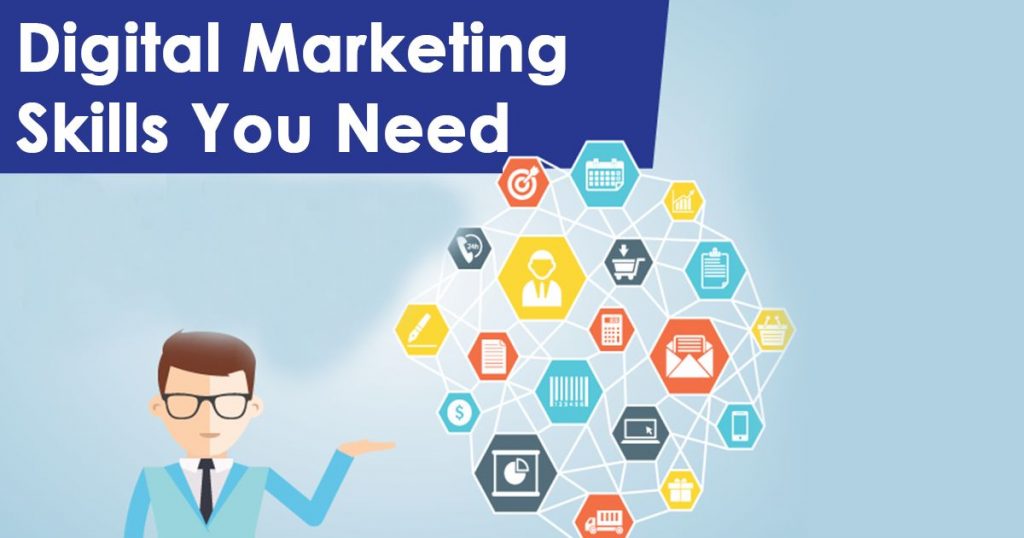
Digital marketing is not one skill. It is a collection of disciplines — some technical, some creative, some analytical, some relational — that together determine whether a practitioner can produce real results for businesses or clients. The challenge for beginners is that the breadth of the field can feel overwhelming. The clarity is in understanding which skills to develop first, which to add over time, and which to develop deeply versus which to understand broadly.
This guide maps the full landscape of digital marketing skills required in 2026: the core channel skills, the technical and analytical skills, the AI capabilities that are now expected as standard, and the soft skills that separate practitioners who get results from those who only know the vocabulary. It also tells you which skills matter most for different career roles — so you can make deliberate choices about where to invest your learning time.
Quick answer: The most important digital marketing skills in 2026 are SEO, Google Ads, GA4 analytics, AI tool proficiency (ChatGPT, Claude, Gemini), Meta Ads, content marketing, and copywriting. Technical skills like GTM and conversion tracking are increasingly expected even at entry level.
Digital Marketing Skills — Complete Guide for 2026
Digital marketing skills are the competencies required to promote products, services and brands through online channels. They span a spectrum from highly technical (implementing GA4 tracking, running Performance Max campaigns with Smart Bidding) to highly creative (writing ad copy that converts, designing scroll-stopping social content) to analytical (interpreting campaign data and making decisions based on it) to interpersonal (managing client expectations, presenting results clearly).
In 2026, digital marketing skills also include AI proficiency — not as an advanced specialisation, but as a workflow expectation. A practitioner who does not use AI tools for content production, research and campaign planning is at a meaningful productivity disadvantage relative to one who does.
The broad skill categories are:
- Core channel skills — SEO, Google Ads, Meta Ads, social media, content, email, video
- Technical skills — GA4, GTM, Search Console, conversion tracking, WordPress, landing pages
- AI skills — ChatGPT, Claude, Gemini, AEO, GEO, prompt engineering, automation
- Soft skills — communication, copywriting, creativity, problem-solving, client management
- Strategic skills — channel planning, budget allocation, performance analysis, campaign thinking
New to the field? Start here — Digital Marketing for Beginners.
Why Digital Marketing Skills Matter in 2026?
The AI Revolution Has Raised the Bar
AI tools have changed what is expected from digital marketers. Content that once took a day to produce can now be drafted in an hour. Campaigns that required constant manual adjustment now optimise automatically through Smart Bidding and Performance Max. Audience targeting that once needed detailed manual configuration is now handled by Advantage+. The bar for what counts as ‘skilled’ has risen — because AI raises the productive output of those who use it well, while the gap between them and those who do not continues to widen.
Demand Consistently Outpaces Supply
India’s digital economy continues growing, and the demand for practitioners with genuine digital marketing skills outpaces supply in most specialisations. This is especially true in technical areas: GA4 implementation, Google Ads with proper conversion tracking, AI marketing and performance marketing with multi-channel attribution. Candidates who develop depth in any of these areas enter a market where they are sought rather than competing against dozens of equivalent applicants.
Remote Work and International Opportunities
Digital marketing skills are among the most location-independent professional competencies available. An SEO specialist in Patiala, a Google Ads manager in Mohali, or a content strategist in Chandigarh can serve clients in Delhi, Mumbai, the UK or the US from the same desk. The income ceiling for practitioners willing to serve international clients is significantly higher than for location-dependent professions.
Business Ownership and Entrepreneurship
For entrepreneurs, digital marketing skills are directly translatable to business growth. Understanding how to run profitable Google Ads campaigns, how to build organic search traffic through SEO, and how to retain customers through email marketing means you can grow your own business without full dependency on agencies or freelancers — and when you do hire them, you are an informed buyer rather than a trusting one.
Core Digital Marketing Skills
Core channel skills are what most people mean when they talk about digital marketing skills. Here is what each involves and why it matters:
Search Engine Optimisation (SEO)
SEO is the ability to improve a website’s visibility in organic search results on Google. It requires understanding how search engines evaluate content (relevance, authority, technical quality), how to conduct keyword research that matches search intent, how to structure on-page content for both human readers and search algorithms, how to identify and fix technical issues, and how to build authority through content and links.
In 2026, SEO also includes AI SEO — understanding how to structure content for Google’s AI Overviews, how to implement schema markup for AI readability, and the emerging disciplines of AEO (Answer Engine Optimisation) and GEO (Generative Engine Optimisation) covered later in this guide.
- Keyword research and search intent analysis
- On-page optimisation — titles, meta, headers, content, internal links
- Technical SEO — Core Web Vitals, crawlability, schema, site speed
- Off-page SEO — link building, digital PR, brand authority
- AI SEO — content structuring for AI Overviews and answer engines
Google Ads (PPC)
Google Ads proficiency means being able to build, manage and optimise paid search campaigns. In 2026, this primarily means working with Smart Bidding strategies and Performance Max campaigns — where the skill is configuring the algorithm correctly (strong conversion tracking, well-structured asset groups, appropriate audience signals) rather than manual bid management.
An effective Google Ads practitioner understands campaign architecture, keyword strategy, Quality Score mechanics, conversion tracking through GA4, and how to diagnose underperformance systematically. They also understand the relationship between ad copy, landing page and Quality Score, and can explain campaign performance to a client in plain language.
Meta Ads
Meta Ads (Facebook and Instagram advertising) requires understanding campaign objectives, audience targeting and creative strategy. Post-iOS 14, the job has shifted significantly toward Advantage+ campaigns, Meta Conversions API for accurate tracking, and creative testing methodology. The ability to conceptualise and test ad creative — images, video, copy combinations — is now the primary performance variable in Meta advertising.
Social Media Marketing
Social media marketing as a skill means understanding the specific dynamics of each platform — what content performs on Instagram Reels versus LinkedIn versus YouTube Shorts — and the discipline to build community consistently over time. It requires content strategy, scheduling, copywriting, basic visual design, and performance analysis. In 2026, it also increasingly involves understanding how platform algorithms reward certain content behaviours and penalise others.
Content Marketing
Content marketing skill means planning and executing content strategy — not just writing articles, but understanding how content clusters work, how to build topical authority, how to structure content for featured snippets and AEO, and how to measure whether content is performing against business objectives. In 2026, it includes using AI tools to accelerate production while maintaining quality and originality.
Email Marketing
Email marketing skill covers list building, segmentation, campaign creation, automation workflow design, deliverability management and performance analysis. At a more advanced level, it includes behavioural drip sequences, A/B testing subject lines and content, and integration with CRM systems. Email marketing proficiency is distinct from social media management — it requires a different technical and strategic skill set and delivers different business value.
Video Marketing
Video marketing skill encompasses scripting, basic production, editing and platform strategy for YouTube, Instagram Reels, YouTube Shorts and similar formats. Not every digital marketer needs to be a video editor — but understanding how to develop a video concept, brief a creator, or produce basic short-form content is increasingly expected as video becomes the dominant organic content format.
Local SEO
Local SEO is optimising for location-based searches — particularly Google Business Profile management, local citation building, review management and geo-targeted content. For practitioners serving local businesses, this is a foundational skill that drives high-intent leads. GBP optimisation, review generation strategy and local citation consistency are the core components.
Understand every channel — Types of Digital Marketing.
Technical Digital Marketing Skills
Technical skills are where many beginners under-invest — and where they most often get separated from candidates who otherwise look similar. These skills are not as glamorous as running ads, but they are what allows marketers to actually measure and improve their work.
Google Analytics 4 (GA4)
GA4 is the standard for web analytics in 2026. The skill is not just understanding what GA4 shows you — it is knowing how to configure it correctly (data streams, event tracking, conversion setup), how to build Exploration reports for specific business questions, and how to interpret the data in ways that inform decisions rather than just describe what happened.
Most job descriptions mention GA4. Most candidates claim proficiency but cannot demonstrate it in a technical interview. The gap is an opportunity: practitioners who can set up GA4 from scratch, build custom Explorations and connect it to Google Ads for conversion import are consistently more employable than those with only surface-level familiarity.
Google Tag Manager (GTM)
GTM allows digital marketers to implement tracking codes, conversion events and third-party scripts on a website without requiring code changes from a developer. The skill includes understanding trigger configuration, variable setup, tag firing sequences and version management. GTM proficiency is particularly valuable because it reduces dependency on development teams for measurement tasks that should be within the marketing team’s control.
Google Search Console
Search Console shows how Google sees your website — which pages are indexed, which queries trigger impressions, which pages have technical issues and how Core Web Vitals are performing. It is a free tool that every SEO practitioner must be fluent with. Regular Search Console auditing reveals opportunities (queries ranking just outside the first page that content improvements could push higher) and problems (pages not being indexed that should be).
Looker Studio
Looker Studio (Google’s free data visualisation tool) allows digital marketers to connect GA4, Google Ads, Search Console, Meta Ads and other data sources into clean, shared dashboards. The skill is knowing how to build reports that are meaningful to clients or stakeholders who are not looking at raw platform data daily. A well-built Looker Studio dashboard demonstrates both technical proficiency and communication skill simultaneously.
Conversion Tracking and Attribution
Setting up and verifying conversion tracking — whether through GA4, Google Ads, Meta Pixel and CAPI, or third-party tools — is a critical technical skill. Without accurate conversion data, campaign optimisation is guesswork. Attribution modelling (understanding how different touchpoints are credited for a conversion) is an increasingly important skill as multi-channel marketing becomes more complex and privacy changes affect platform-reported data.
WordPress Basics
Most digital marketing work involves some interaction with websites, and WordPress powers a significant share of the web. Basic WordPress proficiency — publishing and editing pages and posts, configuring SEO plugins (Yoast, RankMath), checking page speed, and connecting GA4 or GTM — reduces your dependency on developers for tasks that a digital marketer should be able to handle independently.
Landing Page Optimisation
Understanding what makes a landing page convert — clear headline, specific value proposition, minimal friction, social proof, strong CTA — and knowing how to structure, test and improve landing pages is a skill that improves the performance of every paid campaign. A well-designed landing page with the right message can double the conversion rate of a Google Ads campaign at no additional media cost.
AI Skills Every Digital Marketer Needs
AI skills in digital marketing are no longer optional additions to an otherwise complete skill set. In 2026, they are expected as part of the standard toolkit. Here is what each component involves:
ChatGPT
The most widely used AI writing tool in marketing. ChatGPT skills involve more than opening the app and typing a question — effective use requires knowing how to write prompts that produce genuinely useful output, how to iterate on responses to improve quality, and how to identify when AI output needs editing for accuracy, originality and appropriateness. Common applications: content drafts, ad headline variations, email subject line testing, social caption generation, keyword brainstorming.
Claude
Claude is particularly well-suited to tasks requiring nuance, longer structural coherence or careful editing. Many content marketing workflows use Claude as a refinement layer — taking ChatGPT drafts and editing them for tone, natural language quality, and E-E-A-T compliance. For long-form content (pillar articles, detailed guides, case studies), Claude often produces more natural results than other AI writing tools.
Gemini
Google’s AI tool, with direct integration into the Google ecosystem. Gemini is useful for research with real-time data access, analysis tasks that draw on Google tools, and queries where current information matters. As Google integrates Gemini more deeply into its advertising and analytics products, familiarity becomes increasingly relevant for Google Ads and GA4 practitioners.
Perplexity
An AI-powered research tool that provides cited answers — combining the speed of AI synthesis with source-referenced information. For digital marketers who need to find current statistics, track algorithm changes, or conduct competitor research, Perplexity is faster and more credible than a standard search for many queries.
Prompt Engineering
Prompt engineering is the skill of writing instructions to AI tools that produce useful, specific, accurate outputs. The quality of what AI produces is almost entirely determined by the quality of the brief you give it. Effective prompts specify the format, audience, tone, length, what to include, and what to avoid. This is a learnable skill that significantly increases the practical value of any AI tool.
AI SEO — Structuring Content for AI Systems
AI SEO involves understanding how Google’s AI Overviews and AI Mode evaluate and surface content. The skill includes: writing content with direct, early answers rather than lengthy preambles; implementing proper heading hierarchy and FAQ schema; creating content that is specific, accurate and comprehensive enough that AI systems can confidently extract and present it; and monitoring how your content performs in AI-assisted search features.
AEO — Answer Engine Optimisation
AEO is the skill of structuring content to appear in AI-generated answers, featured snippets, voice search responses and AI chatbot answers. It involves: writing direct answers to specific questions early in content; implementing FAQ, HowTo and Speakable schema markup; building topical authority that makes your content a credible source for AI extraction; and understanding which types of queries trigger answer engine features.
GEO — Generative Engine Optimisation
GEO is the skill of optimising content to be cited or recommended by generative AI tools — ChatGPT, Gemini, Claude, Perplexity. Content factors associated with higher AI citation rates include: clearly attributed expert quotations, sourced statistics, precise definitions, comprehensive topic coverage, and identifiable organisational authorship. As AI-generated discovery channels grow, GEO skills will become more systematically important.
Marketing Automation
Marketing automation skill involves configuring systems that deliver personalised marketing communications based on individual customer behaviour — without manual intervention for each interaction. This includes email drip sequences triggered by actions, lead scoring models in CRM systems, chatbot-based lead qualification, and dynamic content personalisation. Tools include HubSpot, Klaviyo, MoEngage and similar platforms.
Soft Skills That Separate Good from Great
Technical skills get you hired. Soft skills determine how far you go and how much you earn. These are the competencies that are consistently underemphasised in digital marketing training — and consistently overvalued by employers and clients.
Communication
The ability to explain what you are doing, why it matters and what the results mean — clearly, to an audience that may not be technically literate — is one of the most valuable skills a digital marketer can have. A campaign that improved cost per lead by 35% has little business impact if the marketer cannot explain the significance of that result to the client or senior stakeholder who controls the budget.
Copywriting
Copywriting is writing that persuades — ad headlines, email subject lines, landing page content, social captions, CTAs. Strong copywriting is specific, audience-aware and focused on the reader’s perspective rather than the brand’s. It is the skill that most directly affects conversion rates across every channel. Improving your copywriting ability improves the performance of everything else you do in digital marketing.
Creativity
Creativity in digital marketing is not about producing art — it is about finding non-obvious approaches to marketing problems. An ad creative that stands out in a crowded feed, a content angle that addresses a question competitors have missed, a campaign concept that connects a brand to an audience in a way the brand had not considered — these are creative contributions with measurable commercial value.
Problem Solving
Digital marketing produces problems continuously: a campaign that was profitable stops performing, a website loses traffic after an algorithm update, a client’s cost per lead doubles in a month. The skill is being able to approach these problems systematically — diagnose the root cause before implementing a fix, test changes with data, and adjust based on evidence rather than assumption.
Client and Stakeholder Management
For agency professionals and freelancers, client management is a skill as important as any technical one. Setting realistic expectations upfront, communicating results clearly and regularly, handling underperformance professionally, and building the trust that drives long-term relationships — these determine whether a professional relationship succeeds. Many technically excellent practitioners lose clients because of poor communication, not poor campaign performance.
Data Literacy
Data literacy is the ability to read, interpret and make decisions based on data — without needing to be a statistician. A digital marketer who can look at a GA4 report and identify which channel is producing the best-quality traffic, or at a Google Ads report and identify which campaign is underperforming relative to its cost, has a practical analytical skill that is consistently sought by employers.
Time Management
Most digital marketers handle multiple campaigns, clients or projects simultaneously. The ability to prioritise effectively — focusing on high-impact activities over low-impact ones, meeting deadlines without allowing one project to deprioritise another, and managing client expectations when timelines are compressed — is a professional skill that compounds over time.
Tools Every Digital Marketer Should Know
Tools are not skills — but proficiency with the right tools is what allows skills to be applied efficiently. Here is a practical overview of the tools that digital marketers encounter most frequently, and what learning each one actually teaches:
| Tool | Category | What It Teaches You |
| Google Ads | Paid Advertising | Search intent, campaign architecture, conversion-focused thinking |
| GA4 | Analytics | User behaviour, funnel analysis, attribution, data-driven decisions |
| Google Tag Manager | Tracking | Implementing measurement without code dependency |
| Google Search Console | SEO | How search engines see your site — rankings, clicks, indexing |
| Semrush | SEO Research | Keyword opportunity identification, competitor gap analysis |
| Ahrefs | SEO + Backlinks | Link authority, content gaps, rank tracking depth |
| Canva | Design | Creating professional visuals without a design background |
| Looker Studio | Reporting | Connecting data sources into clear, stakeholder-ready dashboards |
| ChatGPT | AI Writing | Efficient content drafting, ad copy, ideation |
| Claude | AI Editing | Nuance, longer content quality, E-E-A-T compliance editing |
| Gemini | AI Research | Real-time data, Google ecosystem integration |
| Notion | Organisation | Project and content calendar management |
| Trello | Project Management | Campaign and task tracking across team or client work |
You do not need to subscribe to all of these tools to learn them. Google Ads, GA4, Search Console, GTM and Looker Studio are all free. Semrush and Ahrefs offer free trials. Canva and ChatGPT have free tiers. Notion and Trello have free plans.
How to learn these tools properly — How to Learn Digital Marketing.
Beginner vs Advanced Digital Marketing Skills
Understanding where you are on the skill spectrum — and what the next level looks like — helps you plan your learning deliberately. Here is a comparison across the major skill areas:
| Skill Area | Beginner Level (0–6 months) | Advanced Level (1–3 years) |
| SEO | Keyword research, on-page basics, meta tags | Technical SEO, AI SEO, AEO/GEO optimisation, link building strategy |
| Google Ads | Search campaign setup, match types, basic GA4 linking | Performance Max, Smart Bidding strategy, cross-channel attribution |
| Meta Ads | Campaign objectives, basic audience targeting | Advantage+ campaigns, CAPI setup, creative testing methodology |
| Analytics | GA4 dashboards, basic traffic reports | Custom Explorations, funnel analysis, GA4-to-Ads integration |
| Content Marketing | Writing keyword-targeted blog posts | Content cluster strategy, topical authority, E-E-A-T optimisation |
| Email Marketing | List building, basic newsletters, open rates | Behavioural automation, drip sequences, deliverability management |
| AI Tools | ChatGPT for drafts, Canva AI for images | Multi-tool workflows, GEO strategy, AI content quality control |
| Copywriting | Clear writing, basic CTAs, keyword inclusion | Conversion-focused copy, A/B testing, persuasion psychology |
The pattern across every row in this table is consistent: beginner skills are foundational and conceptual; advanced skills are contextual, integrated and applied to complex real-world situations. The transition happens through practice on real campaigns, not through additional study alone.
How to Build Digital Marketing Skills — Step-by-Step Roadmap
Knowing which skills to develop is only useful if you know how to develop them in the right order. Here is a practical sequence:
Step 1 — Start with SEO and Analytics (Month 1–2)
SEO teaches you how search works, how content quality is evaluated, and how digital information is structured for discovery. These mental models apply to every other channel. GA4 teaches you how to measure what is happening — which is the foundation for every improvement you make thereafter. These two skills together create the framework for everything else.
Step 2 — Add Google Ads (Month 2–3)
Google Ads extends your understanding of search intent into paid territory. It forces you to think about conversion — what happens after the click — and introduces the discipline of measurable ROI. It also reinforces GA4 skills through the conversion tracking setup that makes Google Ads optimisable.
Step 3 — Develop Content and AI Skills (Month 3–4)
Content marketing and AI tool proficiency complement each other: AI tools accelerate content production, while content marketing strategy determines what to produce and how to structure it for SEO and AEO. Developing both together from month three means you build good habits from the start — using AI to speed up work without using it to shortcut quality.
Step 4 — Add Meta Ads and Social Media (Month 4–5)
Meta Ads extend your paid advertising knowledge into interest-based targeting. Social media strategy builds on the content skills developed in step three and adds platform-specific understanding of what works on each channel. The combination of Google Ads (search intent) and Meta Ads (audience interest) covers the two most important paid channels for most businesses.
Step 5 — Deepen Technical Skills (Month 5–6)
GTM, Looker Studio and conversion tracking depth take your analytics skills beyond basic reporting into implementation and presentation. Being able to implement tracking yourself and present results in clean dashboards dramatically increases your value as a practitioner and your independence from developer support.
Step 6 — Specialise and Build Portfolio (Month 6 Onwards)
At this point, choose a specialisation based on what you enjoy most and what the market rewards most (performance marketing and AI marketing are both strong choices in 2026). Build case studies from real campaign work — documented results with specific metrics — and start applying for roles or pitching clients before you feel fully ready.
Step-by-step learning path — Digital Marketing Course in Chandigarh
Common Mistakes While Learning Digital Marketing Skills
| Common Mistake | Why It Holds You Back |
| Collecting certificates without practising | Certificates validate knowledge; employers hire demonstrated ability |
| Learning theory without any real campaign access | Without real data and real stakes, learning stays conceptual |
| Trying to master all skills simultaneously | Depth in 2–3 skills beats breadth in 10 at entry level |
| Measuring only vanity metrics (likes, impressions) | Employers and clients care about leads, sales, ROAS — not follows |
| Ignoring AI tools because they feel advanced | AI is a baseline competency in 2026 — avoiding it creates a gap |
| Not documenting work as it happens | Portfolio work not documented is portfolio work that never existed |
| Stopping learning once employed | The field changes faster than almost any other — continuous learning is non-negotiable |
| Separating soft skills from technical ones | Communication and data literacy together create more value than either alone |
Digital Marketing Skills by Career Role
Different roles require different skill combinations. Here is a practical breakdown of what each role needs most, and what additional skills create the strongest profile:
| Role | Must-Have Skills | Nice to Have |
| SEO Executive | Keyword research, on-page SEO, Search Console, GA4 basics | Technical SEO, AEO, content writing, Ahrefs/Semrush |
| Google Ads / PPC Specialist | Google Ads (Search, PMax), GA4, conversion tracking, Smart Bidding | Shopping ads, YouTube ads, Looker Studio, competitor analysis |
| Meta Ads Specialist | Meta Ads Manager, Advantage+, CAPI, creative strategy | Instagram Reels production, A/B testing, retargeting strategy |
| Performance Marketer | Multi-channel paid (Google + Meta), ROAS/CPA/CPL analytics | Attribution modelling, Looker Studio, first-party data strategy |
| Social Media Manager | Platform strategy (IG/LinkedIn/YouTube), content calendars | Video editing, Canva, paid social basics, influencer coordination |
| Content Marketing Specialist | SEO writing, content clusters, AI content tools, E-E-A-T | Email newsletters, video scripting, GEO/AEO optimisation |
| Digital Marketing Manager | Strategy across channels, GA4, team management, client reporting | Budget allocation, agency management, presentation skills |
| Freelancer / Agency Owner | 2–3 deep channel skills + client communication + GA4 | Business development, proposal writing, project management |
Two patterns are consistent across all roles. First, GA4 is a required skill for every role — not because every practitioner needs to be an analytics expert, but because the ability to read and explain campaign data is expected regardless of your primary specialisation. Second, AI tool proficiency is now expected as a baseline rather than a differentiator — the differentiation is in using AI well, not in using it at all.
See what different roles pay — Digital Marketing Salary in India
Future Digital Marketing Skills (2026–2030)
The digital marketing skills that will be most valuable by 2030 are not entirely different from those that matter in 2026 — but they are more sophisticated versions of them, combined with new capabilities that AI and platform evolution will create.
AI-First Marketing Strategy
By 2028–2030, AI will be embedded in every digital marketing channel — not as a tool some practitioners use, but as infrastructure that all campaigns run on. The skill that will differentiate practitioners is not using AI but making better strategic decisions about how AI tools are configured, what inputs they receive, and how their outputs are evaluated. This is a distinctly human skill: the judgment to direct AI systems effectively.
Predictive Analytics
AI-powered predictive models — forecasting which customers are most likely to convert, churn or upgrade — will move from enterprise-only tools to capabilities accessible to businesses of moderate size. Digital marketers who understand how to use predictive scoring in CRM systems, how to configure propensity models for email targeting, and how to act on predictive insights will be distinctly more effective than those who only work with historical data.
First-Party Data Strategy
As third-party cookies phase out and privacy regulations tighten, the skill of building, managing and activating first-party data assets — email lists, loyalty programmes, CRM databases, app user data — becomes a primary competitive advantage. Digital marketers who understand consent management, data collection strategy and how to activate first-party data across paid and owned channels will be significantly more valuable through 2030.
Voice Search Optimisation
Voice search through AI assistants handles a growing share of local and informational queries. The skill of optimising for conversational queries — longer, more naturally phrased searches, question-answer format content, strong local relevance — will grow in importance as voice search volume expands and as AI assistants become primary interfaces for mobile information queries.
Visual Search
Visual search through Google Lens and similar tools is expanding in e-commerce and local discovery. Digital marketers serving product or location-based businesses will increasingly need to understand how product images, alt text, structured data and visual quality affect discoverability through visual search interfaces.
Personalisation at Scale
Marketing personalisation will move from segment-level to individual-level for most businesses. The skill of designing personalisation systems — using first-party behavioural data combined with AI decisioning to deliver individually relevant content, recommendations and offers — will be one of the highest-value digital marketing competencies through 2030.
The most reliable prediction about future digital marketing skills: they will build on today’s fundamentals, not replace them. A practitioner who deeply understands search intent, conversion measurement and audience behaviour will adapt to AI-powered versions of those disciplines faster than one who understood only the surface features of today’s tools.
Future of Digital Marketing: Trends to Watch
Frequently Asked Questions
What are the most important digital marketing skills in 2026?
The most important digital marketing skills in 2026 are SEO, Google Ads (including Performance Max), GA4 analytics, AI tool proficiency (ChatGPT, Claude, Gemini), Meta Ads, content marketing and copywriting. Technical skills like GTM and conversion tracking are increasingly expected even at entry level. AEO and GEO are emerging skills with growing demand.
Which digital marketing skill should I learn first?
SEO is the strongest starting point because it builds foundational understanding of how search works, how content quality is evaluated, and how digital information is structured for discovery. These mental models apply to every other channel. Google Ads and GA4 are the next most important — each teaches a different dimension of how to measure and improve marketing performance.
Are AI skills necessary for digital marketers?
Yes, in 2026. AI tool proficiency — knowing how to use ChatGPT, Claude or Gemini effectively for marketing tasks, and how to apply AEO and GEO practices — is expected as a baseline competency, not an advanced specialisation. Practitioners who do not use AI tools are at a significant productivity disadvantage relative to those who do.
What technical skills do digital marketers need?
Key technical skills include GA4 (Google Analytics 4), Google Tag Manager, Google Search Console, Looker Studio for reporting, conversion tracking configuration, basic WordPress proficiency and landing page optimisation understanding. These skills are frequently underemphasised in training but consistently overvalued by employers.
What is AEO in digital marketing?
AEO stands for Answer Engine Optimisation — the skill of structuring content to appear in AI-generated answers, featured snippets, voice assistant responses and AI chatbot answers. It involves FAQ-format content, schema markup, direct answers positioned early in content, and topical authority building. As AI tools handle more queries, AEO is an increasingly important SEO-adjacent skill.
What is GEO in digital marketing?
GEO stands for Generative Engine Optimisation — optimising content to be cited or recommended by AI tools like ChatGPT, Gemini, Claude and Perplexity. Content factors associated with higher AI citation rates include expert quotations, sourced statistics, clear definitions and comprehensive coverage. GEO is an emerging skill with growing practical relevance as AI-powered discovery channels expand.
Which digital marketing skills pay the most?
Performance marketing, AI marketing and Google Ads management are among the highest-paying skill specialisations in 2026. They command premiums because: performance marketers are directly accountable to revenue outcomes; AI marketing specialists are in short supply relative to demand; and Google Ads practitioners with proper GA4 attribution skills are consistently sought by agencies and in-house teams. For salary ranges, see Digital Marketing Salary in India.
What soft skills do digital marketers need?
The most important soft skills are communication (explaining results clearly to non-technical stakeholders), copywriting (writing that persuades across channels), problem-solving (diagnosing and fixing underperformance systematically), data literacy (interpreting campaign data and acting on it), and client management (maintaining trust through honest expectation-setting and regular communication).
Can I learn digital marketing skills for free?
You can learn the conceptual foundations and earn certifications for free through Google Skillshop, Meta Blueprint, HubSpot Academy and Semrush. Free learning does not typically provide access to real campaign environments — where practical digital marketing skills actually develop. The most effective learning path combines free certifications with structured training that includes real campaign access.
How long does it take to develop digital marketing skills?
Foundational knowledge and entry-level proficiency can be developed in 3–6 months with structured training that includes live project access. Genuine expertise in a specialisation — the level that commands senior salaries — develops over 2–4 years of hands-on professional practice. The transition from beginner to competent practitioner happens faster with real campaign experience than with any amount of additional study.
What digital marketing skills are needed for freelancing?
Freelancers benefit most from developing 2–3 deep channel skills (SEO, Google Ads and/or Meta Ads are the most sought-after), strong GA4 proficiency (for client reporting), excellent communication and expectation management, and business skills (proposal writing, pricing, project management). AI tools significantly increase freelance productivity — which directly affects how many clients you can serve and what you can charge.
Which digital marketing skills do business owners need?
Business owners benefit most from understanding SEO (how to be found organically), Google Ads basics (what results to expect and what questions to ask), GA4 (how to read and interpret marketing data), and local SEO (for businesses with physical locations). The goal is not to do everything yourself but to be an informed buyer and director of marketing activity. See Benefits of Digital Marketing.
What is the difference between hard skills and soft skills in digital marketing?
Hard skills are technical and channel-specific — SEO, Google Ads management, GA4 configuration, Meta Ads setup, email automation. Soft skills are interpersonal and cognitive — communication, problem-solving, copywriting, data literacy, client management. Both are required for career success: hard skills determine what you can produce, soft skills determine how that production translates into business impact and client retention.
Are digital marketing skills in demand in India?
Yes. Demand for digital marketing skills in India consistently exceeds supply, particularly in technical specialisations: GA4, Google Ads with proper conversion tracking, performance marketing and AI marketing. The geographic spread of demand is also expanding — cities beyond the major metros are developing active digital marketing job markets. For the full picture, see Digital Marketing Scope in India.
How do I prove my digital marketing skills to employers?
The strongest proof of digital marketing skills is a portfolio of documented real results: before-and-after SEO rankings, cost per lead achieved on Google Ads campaigns, conversion rate improvements on Meta Ads. Certifications from Google Skillshop, Meta Blueprint and HubSpot add credibility. The ability to answer technical follow-up questions in an interview — which requires genuine practical experience, not memorised talking points — is what separates candidates who pass the initial screen from those who get offers.
Conclusion
Digital marketing skills in 2026 span a wider range than most beginners anticipate — from technical analytics configuration to creative copywriting to AI workflow design to client communication. The good news is that you do not need to master all of them before starting. You need to start with the right foundation, practise on real campaigns, develop depth in one or two specialisations, and treat learning as an ongoing professional responsibility.
The skill hierarchy is clear: SEO and GA4 form the foundation. Google Ads and Meta Ads are the next most important. AI tool proficiency (ChatGPT, Claude, Gemini, AEO, GEO) is now expected as a baseline. Copywriting and communication are the soft skills that determine how far those technical skills actually take you.
The practitioners who build the strongest digital marketing careers are not the ones who know the most — they are the ones who can apply what they know to real business problems, document the results, and communicate the impact clearly. Those capabilities develop through practice, not just study.
Build Real Digital Marketing Skills with Live Campaign Access
1313 Digital Marketing Institute (1313 DMI) — the training division of Solutions1313 — teaches digital marketing skills inside an active digital marketing company. Students develop practical skills on real campaigns, with real data, guided by practitioners who manage live client accounts. Based in Chandigarh, Mohali and Patiala since 2009.
Ace Your Interview with Digital Marketing Interview Questions
Related Guides:
- What is Digital Marketing?
- Is Digital Marketing a good career?
- Digital Marketing Tools
- Digital Marketing Jobs
- Career in Digital Marketing
- Digital Marketing Strategy
- AI in Digital Marketing
- Digital Marketing Trends
- Digital marketing Roadmap
- Digital Marketing Course in Mohali
- Digital Marketing Course in Patiala
- SEO Course
- Google Ads Course
You can reach out to us at-
Phone: +91 92160 41313 | +91 93331 41313
Email: admin@solutions1313.com
Chandigarh: SCO 60-62, 2nd Floor, Sector 17-C
Mohali HQ: SCO 54, 2nd Floor, Sector 82, JLPL, Airport Road
Patiala: #44 B.N. Khalsa School Complex, Sirhind Road
Book a Free Demo Class — Call +91 92160 41313 | admin@solutions1313.com
