

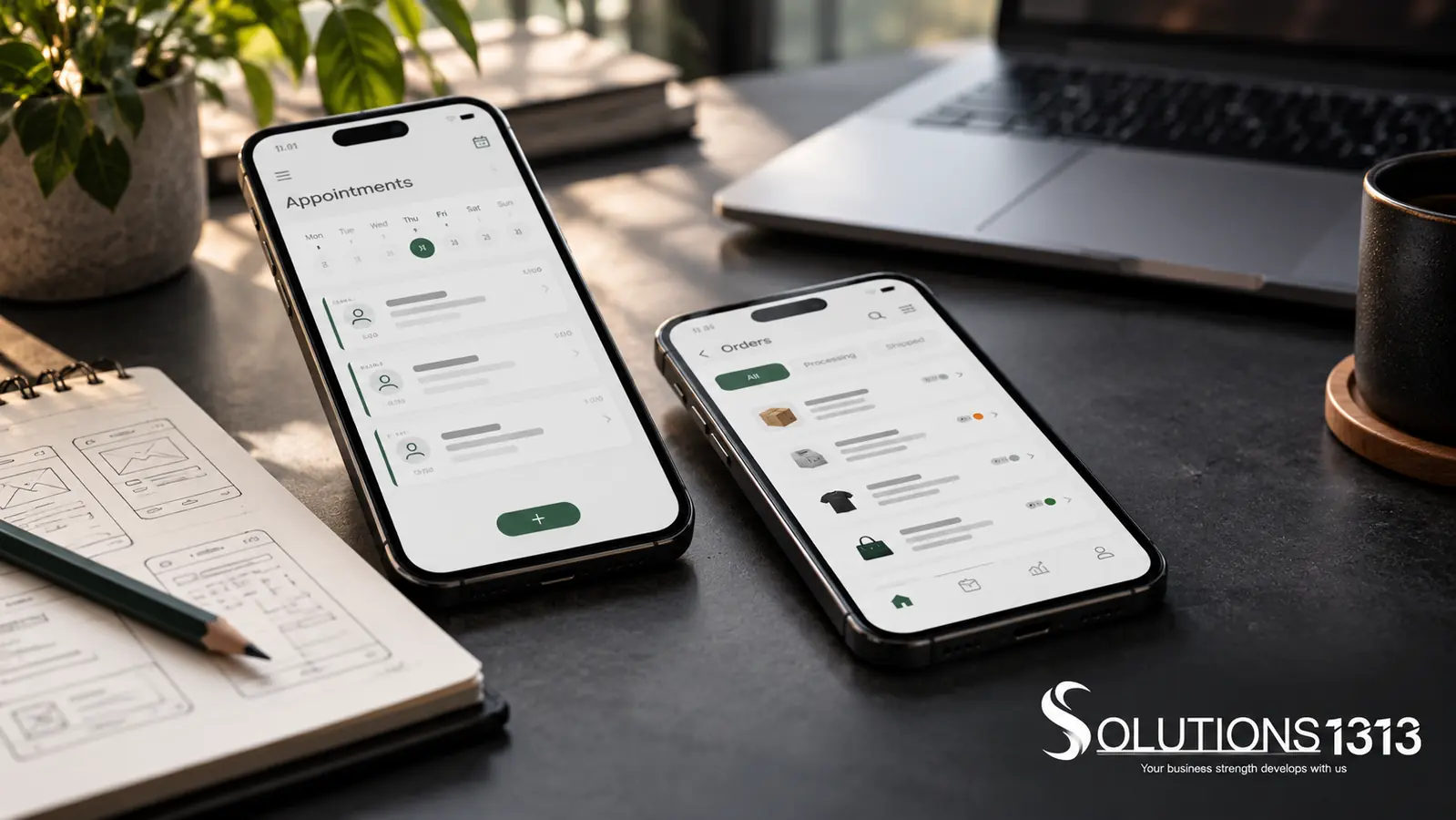
Mobile app development cost in India depends on the work behind each user journey: the screens, business rules, backend, integrations and testing. Start with a written scope before comparing prices. Solutions1313 currently lists a simple Android or iOS app from ₹90,000. That is a published company starting price, not an India-wide average or a quote for every app.
A booking app, for example, needs more than a calendar screen. Someone must define availability, cancellations, notifications and what staff can change. Those decisions affect both the build cost and the cost of running the app.
This guide helps business owners compare proposals, separate launch work from ongoing charges and decide what belongs in the first release.
In This Guide
How To Use A Published Starting Price
The Solutions1313 app development service page lists simple apps from ₹90,000, ecommerce apps at ₹1.5–₹3 lakh and on-demand apps at ₹2–₹5 lakh or more. These are reference figures checked on 25 October 2026. A proposal should explain the exact scope behind the applicable price.
Do not assume a starting price includes both mobile platforms, a custom admin panel, every integration or ongoing support. Ask for a clear statement of inclusions, exclusions, applicable taxes and third-party charges. The signed scope should take precedence over a general website example.
A useful first brief describes who will use the app, their main task and what a successful transaction looks like. Include the staff workflow as well as the customer journey. This gives each agency the same problem to estimate.
What Changes An App Development Quote?
Screen count is only part of mobile app development cost in India. Two apps can have the same number of screens and very different rules, data needs and testing requirements.
| Scope Decision | What To Clarify Before A Quote |
|---|---|
| User roles | Customer, staff, vendor and administrator permissions; whether each needs a separate interface. |
| Core workflow | Booking, ordering, approval or delivery steps, including cancellations and failed transactions. |
| Backend and admin | Who manages records, prices, availability, refunds and reports; whether an existing system can be used. |
| Integrations | Payment, CRM, maps, messaging or inventory services, plus their limits and ongoing fees. |
| Data and reliability | Offline use, synchronisation, existing data migration, backup and recovery needs. |
| Design and accessibility | Custom layouts, supported devices, readable text, touch targets and accessible user journeys. |
Consider a fictional appointment app. A first release might let a customer choose a service, select an available slot and receive a confirmation. Adding several branches, staff commissions, subscriptions and complex rescheduling creates additional work. This example illustrates scope; it is not a Solutions1313 client project or a price estimate.
Separate Essential Features From Later Ideas
Write one list for features that must work at launch and another for useful additions. Keep account access, reliable transactions and essential safeguards in the launch scope. Move optional dashboards or loyalty features only when the business can operate without them.
Ask the developer to explain dependencies. A feature that looks optional may require an early data or architecture decision. Phasing work can control scope, but it does not make later development free.
Should You Build For Android, iOS or Both?
Choose platforms using evidence about your customers, existing website traffic and the devices used by staff. Geography alone is not enough to decide. If demand is uncertain, validate the workflow with a prototype or a smaller first release before funding a wider build.
A shared codebase can reduce duplicated work in suitable projects. However, both platforms still need testing, release preparation and platform-specific fixes. Native development may suit specialised device features or demanding performance requirements. Ask the agency to explain its recommendation against your actual needs.
Also check whether an app is necessary. If customers mainly need information and an occasional enquiry form, a responsive website may meet the need. Our business website cost guide explains how to scope that alternative.
Budget For Costs After Launch
The development invoice and the operating budget are different. An app may rely on paid infrastructure or services even when you make no feature changes. Confirm which charges go directly to your business and which pass through the agency.
- Infrastructure: hosting, databases, storage, backups and monitoring.
- Usage-based services: messaging, maps, payment processing and other APIs.
- Platform accounts: developer accounts and any applicable registration or renewal charges.
- Maintenance: operating-system compatibility, dependency updates and agreed bug fixes.
- Operations: customer support, content administration and any manual work the app leaves with your team.
Request low, expected and higher-usage scenarios based on stated assumptions. For example, the estimate should say how many messages or transactions it assumes. These scenarios support planning; they are not promises about future demand.
Define the support arrangement separately: response hours, issue priorities, included work and charges for new features. A warranty for defects does not automatically cover later changes to business rules.
Compare App Development Proposals On The Same Basis
Ask every shortlisted supplier to respond to the same brief. Then compare the following items, rather than treating the lowest total as a like-for-like offer.
- Deliverables: list the platforms, user roles, workflows, admin features and integrations.
- Acceptance criteria: describe how your team will decide that each workflow works.
- Responsibilities: name who supplies copy, policies, product data, accounts and approvals.
- Milestones: connect payments and review points to agreed deliverables.
- Change handling: explain how additional requests affect cost and schedule.
- Handover: confirm access to source code, repositories, design files and deployment documentation.
- Support and exclusions: identify recurring fees, warranty terms and work outside the quote.
A useful proposal also identifies uncertainties. If an existing system has no documented API, the agency may need a discovery step before pricing the integration. A clearly explained assumption is more useful than a precise-looking total that ignores unresolved work.
Agree On Testing, Ownership And Release Responsibilities
Test the complete customer journey, including failed payments, lost connections, incorrect input and account recovery where relevant. Agree which devices and operating-system versions the team will cover. Your business should review the release against the acceptance criteria before launch.
Google Play documents internal, closed and open testing options. Applicable release requirements depend on the account and app. Confirm the current requirements during planning instead of assuming that development completion means immediate public availability.
Apple’s App Review Guidelines also cover responsibilities that extend beyond the visible screens, including third-party components. An agency can prepare and support a submission, but platform review remains a separate process. No supplier can guarantee approval.
Keep business-critical accounts under company-controlled ownership. Define the agency’s access, handover steps and what happens if the working relationship ends. Include clear documentation so a future team can maintain the app.
Frequently Asked Questions
Is ₹90,000 enough for my app?
Solutions1313 has listed ₹90,000 as a starting price for a simple app. Whether its enough for your project depends on the features you need, the platforms you want to support, and the backend work involved. You should ask the company to give you a written quote that clearly lists what is included and what will cost extra.
Is a cross-platform app always cheaper?
No. A cross-platform app can save time and efforts because much of the code is shared between Android and iOS. However, the cost still depends on features, integrations, and testing required. Ask the developer which approach suits your app and what is included in the price.
Does the development quote include app-store fees?
Only if the proposal says so. Ask who owns the developer accounts, who pays platform charges and whether submission support is included. Check current fees with the relevant platform.
Can I add features after launch?
Yes, subject to the app’s architecture and a new agreed scope. Discuss likely future needs early so the first release does not make them unnecessarily difficult.
Can an agency guarantee the launch date?
A schedule should state assumptions about approvals, supplied content, integrations and store review. Request milestones and a process for handling delays, rather than relying on an unconditional date.
Discuss the scope before setting the final budget
Send Solutions1313 a short outline of the users, main workflow, preferred platforms and existing systems. Call +91 92160 41313 to discuss a written proposal with inclusions, exclusions and ongoing costs. A useful first conversation should make the scope clearer before you commit to development.
