
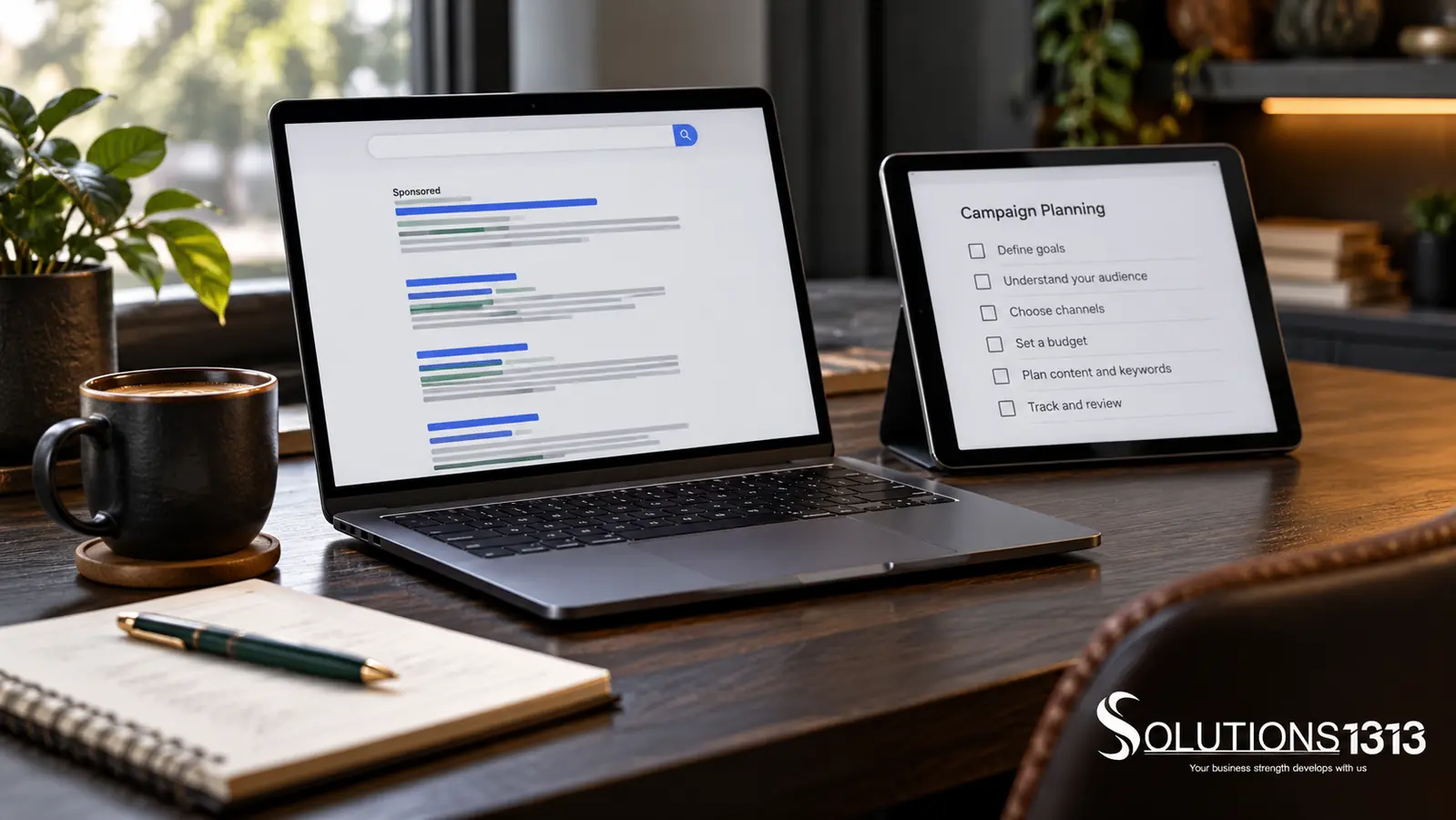
When comparing Google Ads vs SEO, start with the business need. Google Ads can place paid messages in front of relevant searches when campaigns are eligible and funded. SEO improves the website’s ability to earn organic visibility over time. The better first investment depends on demand, website readiness, measurement and the budget you can sustain.
A small business does not have to choose one channel permanently. However, splitting a limited budget before either channel has a clear plan can make both harder to evaluate. Choose a specific goal, make the website ready to receive enquiries and define how you will review the result.
In this guide
Google Ads vs SEO: the practical differences
Paid and organic search can reach people with similar questions, but they work differently. Buying advertising does not buy better organic rankings. Google explains this separation in its paid and organic reporting guidance.
| Decision | Google Ads | SEO |
|---|---|---|
| How visibility is earned | Eligible ads compete for paid placements under campaign settings and auction conditions. | Search systems evaluate accessible, relevant pages for organic results. |
| Budget structure | Media spend, management and any landing-page or measurement work. | Research, content, technical implementation and ongoing review. |
| Speed of feedback | Campaigns can produce traffic data after serving begins; useful conclusions still need enough relevant evidence. | Changes need time to be discovered and evaluated; results vary by site and search demand. |
| Control | Campaign settings help manage targeting, spending and messages within platform rules. | You control the website improvements, but cannot select a guaranteed organic position. |
| When spending stops | Paid visibility depends on active, funded campaigns. | Existing pages may continue to attract visits, but positions and traffic can change. |
Neither channel guarantees enquiries or sales. A relevant visitor still needs a clear offer, a usable page and a business that responds well.
When paid search may be a sensible first step
Google Ads may suit a business with a defined offer, clear service area and a landing page that answers the buyer’s main questions. It can also help test which search themes produce relevant enquiries, provided the campaign and measurement are set up carefully.
For example, a fictional repair business might start with one service and the locations it can actually cover. The test could focus on calls during staffed hours. This gives the business a narrower question to answer than whether advertising “works” in general.
Before spending, agree who reviews search relevance, locations, enquiries and wasted activity. A broad campaign with weak follow-up can use its budget without answering the business question.
Paid search is less attractive when the website is unclear, the business cannot respond to enquiries or the expected customer value does not justify the acquisition cost. Fixing those problems may be the first investment.
When SEO may be a sensible first step
SEO may deserve priority when the business has an ongoing need for discovery and its website lacks useful, accessible service or product information. It can also address technical barriers that affect important pages.
Start with what customers need to understand before contacting you: availability, suitability, process, limitations and the next step. Improve the existing page where it already serves that purpose. Create a new page only when the topic has a distinct role.
SEO requires implementation and review. A list of recommendations will not improve a page unless someone carries out the work. Our SEO services for Chandigarh businesses page outlines the service; a proposal should identify the work relevant to your site.
Do not choose SEO because someone promises free customers or a fixed ranking date. Organic visits do not carry an advertising click charge, but useful content, development and maintenance still cost time and money.
Check the website before buying more traffic
A visitor should quickly understand what you offer, where it is available and how to take the next step. Test the page on a phone as well as a desktop. Then check the full enquiry journey rather than judging the design alone.
- Match the promise: the page should answer the service or product need behind the search.
- Explain the offer: use real information about scope, process and any relevant limitations.
- Make contact practical: show a correct phone number and an enquiry form that asks for useful information.
- Remove friction: check readability, navigation, loading behaviour and form errors.
- Measure useful actions: define calls, form enquiries or purchases carefully and avoid counting every button click as a sale.
- Plan follow-up: assign responsibility for reviewing and responding to enquiries.
If the site needs a rebuild or a new landing page, include that work in the overall plan. The business website cost guide explains how to compare build scope and ongoing charges.
Plan a budget and a review process
There is no single Google Ads budget or SEO fee that suits every small business. Search demand, competition, geography, margins and the buying journey all affect the decision. Ask for assumptions and responsibilities, not a universal spend figure.
Separate the costs
For advertising, distinguish the amount paid to the platform from agency management, creative work and landing-page development. For SEO, separate the retainer from any excluded content or technical implementation. Use our monthly SEO budget and deliverables checklist to compare that scope. Ask whether taxes and third-party charges are included.
Define a useful outcome
Choose a business measure you can explain. A qualified enquiry may be a person in your service area asking for a service you actually provide. Record unsuitable enquiries separately. This makes the report more useful than a single total that mixes every contact together.
Cost per qualified enquiry is the relevant acquisition cost divided by qualified enquiries for the same period and scope. State which costs are included. If there are no qualified enquiries, report that directly rather than presenting a misleading cost figure.
Agree on review and stop rules
Set a spending boundary for any advertising test and agree who can change it. Review search relevance, measurement quality and landing-page problems before increasing spend. Pause or revise a campaign when the evidence identifies a problem that further spending will not solve.
For SEO, review completed implementation and changes in relevant search performance. Google’s SEO Starter Guide explains why website changes need time to be reflected. Use review points to assess evidence and priorities, not to promise a ranking by a fixed date.
Use both channels without confusing the results
Businesses can use advertising for selected immediate priorities while improving useful pages for organic discovery. This only helps when the work has clear ownership and the budget supports both plans.
Search and enquiry patterns from campaigns can suggest questions worth explaining on the website. Likewise, useful organic pages can reveal services or topics that deserve a closer paid-search test. Treat these as hypotheses to check; success in one channel does not guarantee success in the other.
Keep reporting separate enough to see paid spend, organic performance and enquiry quality. Also acknowledge that a customer may encounter the business more than once before making contact. Attribution reports are a measurement view, not a complete record of every influence on a sale.
Frequently asked questions
Does paying for Google Ads improve SEO rankings?
No. Advertising investment does not improve organic search ranking. Paid placements and organic results are separate.
Is SEO free?
Organic visits do not require an advertising payment for each click. However, research, content, development, maintenance and measurement still require resources.
Will Google Ads bring leads immediately?
Ads can generate visits after campaigns become eligible and start serving. Relevant leads depend on demand, targeting, the offer, the page and follow-up. Immediate leads are not guaranteed.
Should a new business use both from the first month?
Only if there is a clear scope and enough budget to carry out and evaluate both plans. A focused first step may be easier to assess when resources are limited.
Which channel should I stop if the budget is tight?
Review the evidence, remaining work and business priorities before deciding. Do not remove a useful activity solely because another channel reports more raw clicks. Compare relevant enquiries, costs and the reliability of the measurement.
Choose the first step around your business goal
Share your website, main offer, service area and budget constraints with Solutions1313. For a paid-search discussion, see our PPC management service or call +91 92160 41313. Ask for a plan that separates media spend, service fees, website work and the evidence used to review progress.
