
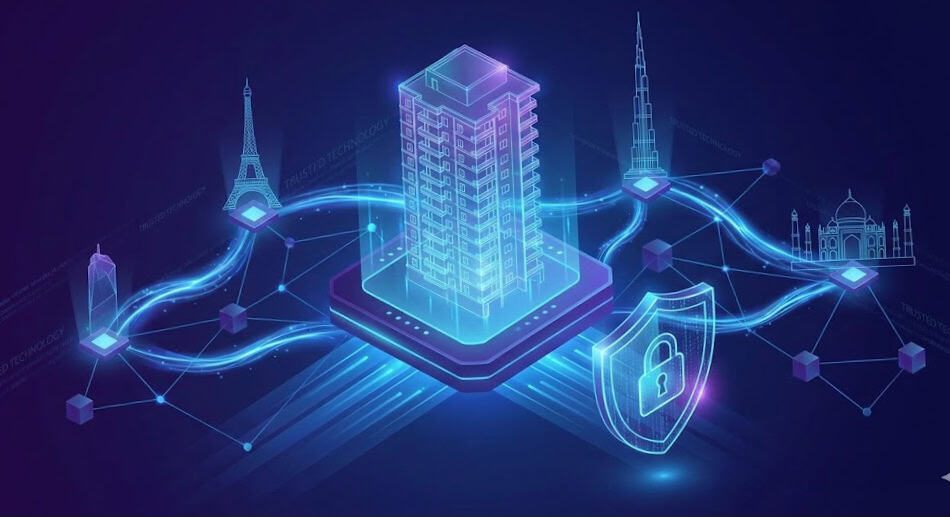
 Are you looking for blockchain in Real Estate India? You’re at the right place. We provide the best blockchain real estate solutions.
A INR 45 crore commercial property in Bangalore was tokenized into 45,000 tokens of INR 10,000 each in 2025. Eight hundred and forty-seven investors participated in the first offering of INR 8 crore. The offering closed in 19 days. None of these investors could have participated in this property through traditional real estate channels — the minimum ticket size would have excluded most of them. Solutions1313 built the tokenization platform. The work involved six months of development, three legal consultation rounds to navigate SEBI’s evolving security token framework, and two audit cycles. It also showed what blockchain genuinely adds to Indian real estate — not hype, but measurably expanded access to an asset class that previously required crores to enter.
Indian real estate has specific problems blockchain addresses at the infrastructure level. Land title disputes are among the most common civil litigation cases in India — often arising from paper records that can be altered, duplicate registrations, and unclear inheritance chains. Fractional property ownership is commercially impractical without a digital infrastructure for tracking thousands of small ownership stakes. And property transaction timelines that stretch to months involve intermediary costs that smart contracts eliminate.
📍 6 Offices: Mohali HQ + 5 India Branches + Dubai, Business Bay ✅ Free Consultation ✅ Free Project Roadmap
The Real Problem Blockchain Solves in Indian Real Estate
The Indian real estate sector has a well-documented and significant fraud problem. The Ministry of Housing and Urban Affairs has identified title fraud as a primary challenge in property markets across major Indian cities. It is easy to alter manual paper records. Duplicate registrations are discovered months after transactions close. Inheritance disputes run for years because ownership histories are ambiguous. Blockchain creates an immutable ownership registry where every transfer is permanently recorded and any party can verify the complete title history independently.
The access problem is equally significant. India’s largest asset class by value is effectively inaccessible to anyone without significant capital. Tokenization changes this equation by dividing ownership into units that retail investors can afford — creating a market for property investment that India’s growing middle class can participate in for the first time.
Our Blockchain in Real Estate India Solutions
Property Tokenization Platform
We build tokenization platforms compliant with SEBI’s evolving digital securities framework and RERA documentation requirements. Platforms include legal document hash storage on-chain, KYC-gated investor onboarding, automated rental income distribution to token holders, and secondary market trading for fractional shares.
Smart Contract Property Escrow
Smart contract escrow holds buyer funds on-chain and releases them automatically when verified conditions are met — property documents submitted, registration confirmed, or conditions defined by the parties. Neither party can manipulate the escrow once deployed.
Digital Title Registry
Immutable on-chain ownership records create a verifiable title history that any party can query independently. The system records every ownership transfer permanently with a timestamp and transaction proof.
Real Estate DAO
Community-governed real estate investment pools where token holders vote on acquisitions, management decisions, and fund distribution — democratizing access to institutional-scale property investment.
Key Benefits
- Fraud prevention through tamper-proof ownership records.
- Fractional investment enabling INR 10,000 participation in multi-crore properties.
- Faster transaction settlement through smart contract automation.
- Transparent pricing through verifiable on-chain transaction history.
- Reduced intermediary costs as smart contracts replace manual escrow processes.
Why Choose Solutions1313?
- Solutions1313 — Mohali HQ, 5 India branches, Dubai Business Bay.
- Reference project: INR 45 crore property tokenization, 847 investors, 19-day close.
- SEBI and RERA framework awareness built into every real estate blockchain engagement.
- Free consultation and free project roadmap for real estate technology initiatives.
Our Other Services
At Solutions1313, we provide a wide range of software development services including:
- Blockchain Development Company India
- Smart Contract Development India
- Token Development India
- Enterprise Blockchain Solutions India
- Hyperledger Development India
Frequently Asked Questions
Is property tokenization legal in India?
Property tokenization operates in an evolving regulatory environment in India. Tokens representing property ownership stakes are likely classified as securities under SEBI regulations, requiring compliance with applicable securities law for issuance and trading. We strongly recommend legal consultation before launch. We build the technical infrastructure to be compliance-ready as regulations clarify.
How much does a blockchain real estate platform cost in India?
A smart contract escrow system starts from INR 2,00,000 to INR 5,00,000. A complete property tokenization platform with investor dashboard, KYC, and secondary market trading ranges from INR 15,00,000 to INR 50,00,000. Contact our Mohali or Dubai office for a free assessment.
How does property tokenization work practically?
A property is legally structured to allow fractional ownership — typically through a Special Purpose Vehicle (SPV). The SPV’s ownership rights are divided into tokens on a blockchain. Investors purchase tokens to acquire proportional ownership stakes. The smart contract automatically distributes rental income to token holders. Token holders can trade their stakes on the secondary market without the property changing hands.
Can blockchain prevent property fraud in India?
Blockchain creates an immutable ownership record that cannot be altered without network consensus. Once a property’s title history is on-chain, duplicate registrations and retroactive document alterations are detectable by any verifying party. The limitation is that data entered incorrectly at initial registration is still incorrect — blockchain prevents subsequent fraud, not fraudulent initial data entry.
Which blockchain is best for real estate applications?
For retail investor platforms, Polygon offers low-cost transactions that are accessible to small investors. In contrast, for institutional platforms that require compliance features and security token standards, Ethereum with ERC-1400 or ERC-3643 provides the appropriate regulatory framework. Finally, for enterprise consortium title registries involving multiple government departments, Hyperledger Fabric provides a permissioned architecture suitable for government data.
How long does a real estate blockchain platform take to build?
A smart contract escrow system takes 4 to 8 weeks. In contrast, a full property tokenization platform with compliance infrastructure, an investor portal, and a secondary market takes 4 to 8 months, depending on regulatory requirements and integration complexity.
Content Reviewed By
Solutions1313 Team
Blockchain Real Estate & PropTech Specialist | Solutions1313 | Mohali, Chandigarh (HQ) | 5 India Branches | Dubai — Business Bay | Free Consultation | Free Project Roadmap
Build Your Blockchain in Real Estate Platform
Free consultation from our Mohali or Dubai team. Property tokenization, escrow, or title registry — we scope it accurately.