
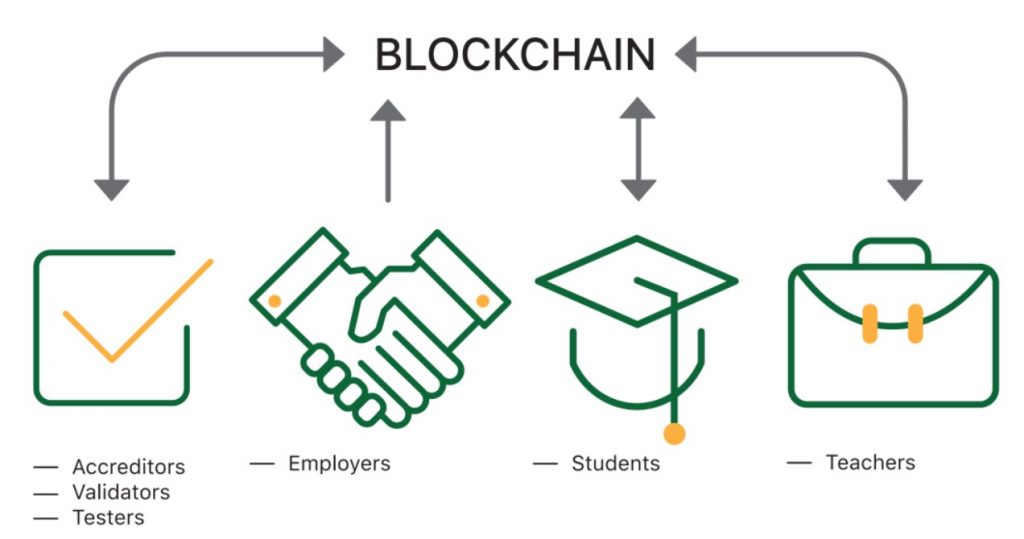
Blockchain in education in India is enabling secure verification of academic credentials, transparent record-keeping, and tamper-proof certification systems that improve trust between institutions, employers, and students.
India’s fake degree problem is documented at scale. Thousands of fraudulent degrees and certificates are discovered annually by employers, causing direct financial losses through bad hires and regulatory liability when professionals in licensed fields hold fake qualifications. A blockchain credential system makes fake degrees impossible to produce — not difficult to detect after the fact, but impossible to create in the first place. Solutions1313 builds blockchain credential systems for universities, professional certification bodies, and edtech companies where every credential is issued to an immutable on-chain record that any employer can verify instantly without contacting the institution.
India’s National Academic Depository (NAD) framework already establishes the policy intent for digital academic credentials. Blockchain provides the trust infrastructure to realize that intent in a way that is independently verifiable — employers can confirm a credential’s authenticity without trusting a single company’s database, because the record is on a public blockchain that no single party controls.
📍 6 Offices: Mohali HQ + 5 India Branches + Dubai, Business Bay ✅ Free Consultation ✅ Free Project Roadmap
The Real Scale of India’s Credential Fraud Problem
The problem is not limited to degree mills. Experienced professionals inflate credentials — adding institutions they did not attend, qualifications they did not earn, grades that were lower than claimed. The verification cost for employers doing thorough background checks runs thousands of rupees per candidate for manual verification processes that still have gaps. Blockchain verification costs the same regardless of volume — verifying a credential on-chain takes seconds and costs nothing for the verifier.
For education institutions, the reputational benefit of blockchain-verified credentials is direct. An institution whose graduates carry verifiable blockchain credentials eliminates the possibility of fake versions of those credentials circulating in the market. The institution’s brand is protected by mathematical proof.
Our Blockchain in Education India Solutions
Digital Credential Issuance Platform
Universities and certification bodies issue credentials as blockchain records linked to the recipient’s digital wallet or email. Recipients own their credentials and share verification links independently. Verifiers click a link and see instant cryptographic confirmation — no institutional contact required.
Academic Record Management
Student transcripts, grade records, and continuing education histories stored as blockchain credentials. Students authorize access for scholarship applications, graduate admissions, and employer background checks without surrendering data control to the requesting party.
NFT-Based Micro-Credentials
Skill certifications, course completions, and professional development badges issued as NFTs that recipients accumulate in a verifiable digital portfolio. Popular with edtech platforms and professional certification bodies targeting the growing Indian online learning market.
Anti-Plagiarism Research Registry
Research findings and datasets timestamped on-chain before publication. Immutable proof of intellectual priority. Used by Indian research institutions to protect against plagiarism and establish verifiable contribution records for funding applications.
Blockchain in Education Cost in India
- Basic digital credential issuance platform for single institution: INR 3,00,000 to INR 8,00,000.
- Multi-institution credential network with mobile verification app: INR 10,00,000 to INR 30,00,000.
- NFT micro-credential platform for edtech: INR 4,00,000 to INR 12,00,000.
- Free consultation and free platform roadmap available.
Why Choose Our Blockchain in Education India Company?
- Solutions1313 — Mohali HQ, 5 India branches, Dubai Business Bay.
- NAD-aligned development for India’s National Academic Depository framework.
- NFT and cryptographic hash credential options for different institution requirements.
- Free consultation and free project roadmap.
Our Other Services
Apart from blockchain in education India, we also offer various other digital services including:
- Blockchain Development Company India
- Smart Contract Development India
- Token Development India
- NFT Marketplace Development India
- Enterprise Blockchain Solutions India
Frequently Asked Questions
How much does a blockchain in Education System cost in India?
A basic platform for a single institution starts from INR 3,00,000 to INR 8,00,000. A multi-institution network with mobile verification ranges from INR 10,00,000 to INR 30,00,000. Contact our Mohali or Dubai office for a free assessment.
How does blockchain prevent fake degrees?
When a university issues a degree through a blockchain credential system, the record is written to an immutable on-chain address from the institution’s verified blockchain identity. Fake degrees cannot be created because they would not have a corresponding on-chain record from the institution’s address. Any employer can verify authenticity in seconds.
Can students carry their credentials independently?
Yes. The system issues blockchain credentials to the student’s digital wallet or email. Students carry and share them independently via a QR code or verification link included on their resume or LinkedIn profile. No institutional contact needed for verification.
Is blockchain credential verification accepted in India?
Blockchain credential verification is growing in acceptance in India. The NAD framework creates institutional alignment. Employers who understand the verification process accept blockchain credentials as more reliable than paper certificates. Adoption is growing as verification familiarity increases.
Can you revoke blockchain credentials ?
Yes. A revocation contract records revoked credentials on-chain. Verification systems check both the issuance record and the revocation registry, displaying credentials as revoked where applicable. Institutions retain the ability to revoke fraudulently obtained credentials.
What is the difference between a blockchain credential and a digital certificate PDF?
Anyone can forge a PDF certificate by editing the file. An institution issues a blockchain credential that cryptographically links to an on-chain record from its verified address. Modifying the credential invalidates the cryptographic proof — the forgery is immediately detectable to any verifier.
Content Reviewed By
Solutions1313 Team
EdTech Blockchain & Digital Credential Specialist | Solutions1313 | Mohali, Chandigarh (HQ) | 5 India Branches | Dubai — Business Bay | Free Consultation | Free Project Roadmap
Build Your Blockchain in Education India System
Free consultation from Mohali or Dubai. Digital credentials, certificate verification, or anti-fake systems — we scope it accurately.